SMB walkthrough: AEO for local shops and "near me" searches
Who this is for: a single-location, hyperlocal business, a shop, studio, or service that lives or dies on “best [your service] near me” and local delivery or booking. If your customers are one town, not one country, this walkthrough is for you. For the strategic overview first, see Zicy for Small and Mid-Sized Businesses.
This walkthrough follows one real setup, screen by screen, so you can see what the product actually returns rather than a description of it.
Step 1: Create your brand profile
Section titled “Step 1: Create your brand profile”The same paste-URL-and-Analyze flow as any other business. For a real independent Kuala Lumpur florist, auto-fill correctly produced:
- Industry: “Online florist / Flower & gifting e-commerce”
- Products: Fresh flower bouquets, Bloom boxes, Flower baskets, Vase arrangements, Flower stands, Hand-tied bouquets
- Primary Location: Malaysia, with no Secondary Location set, correctly reflecting a purely local business
- Brand Tone: “Friendly, celebratory, modern and approachable”
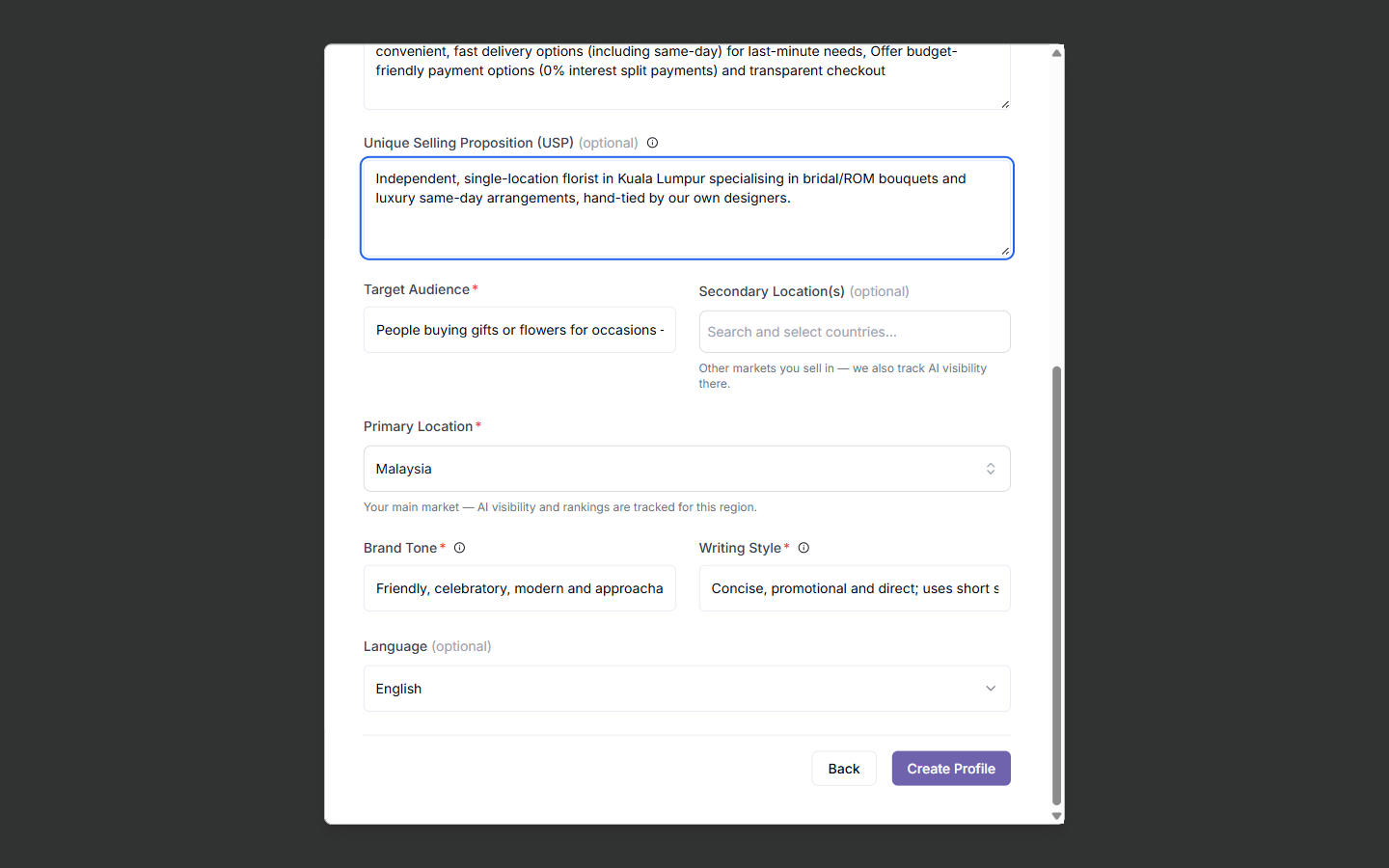
The Unique Selling Proposition field needed to be filled in by hand, and it is where a business tells Zicy what actually makes it different from the big national flower-delivery chains that otherwise dominate “florist near me” answers (for example, “independent, single-location, specialise in bridal/ROM bouquets, hand-tied by our own designers”).
Step 2: Run your Site Audit
Section titled “Step 2: Run your Site Audit”The same Site Audit as any other business, but a real difference showed up here: this site had a working sitemap, so Zicy discovered 752 real pages automatically before the audit even ran, against “no sitemap found” for the exporter site in the companion walkthrough.
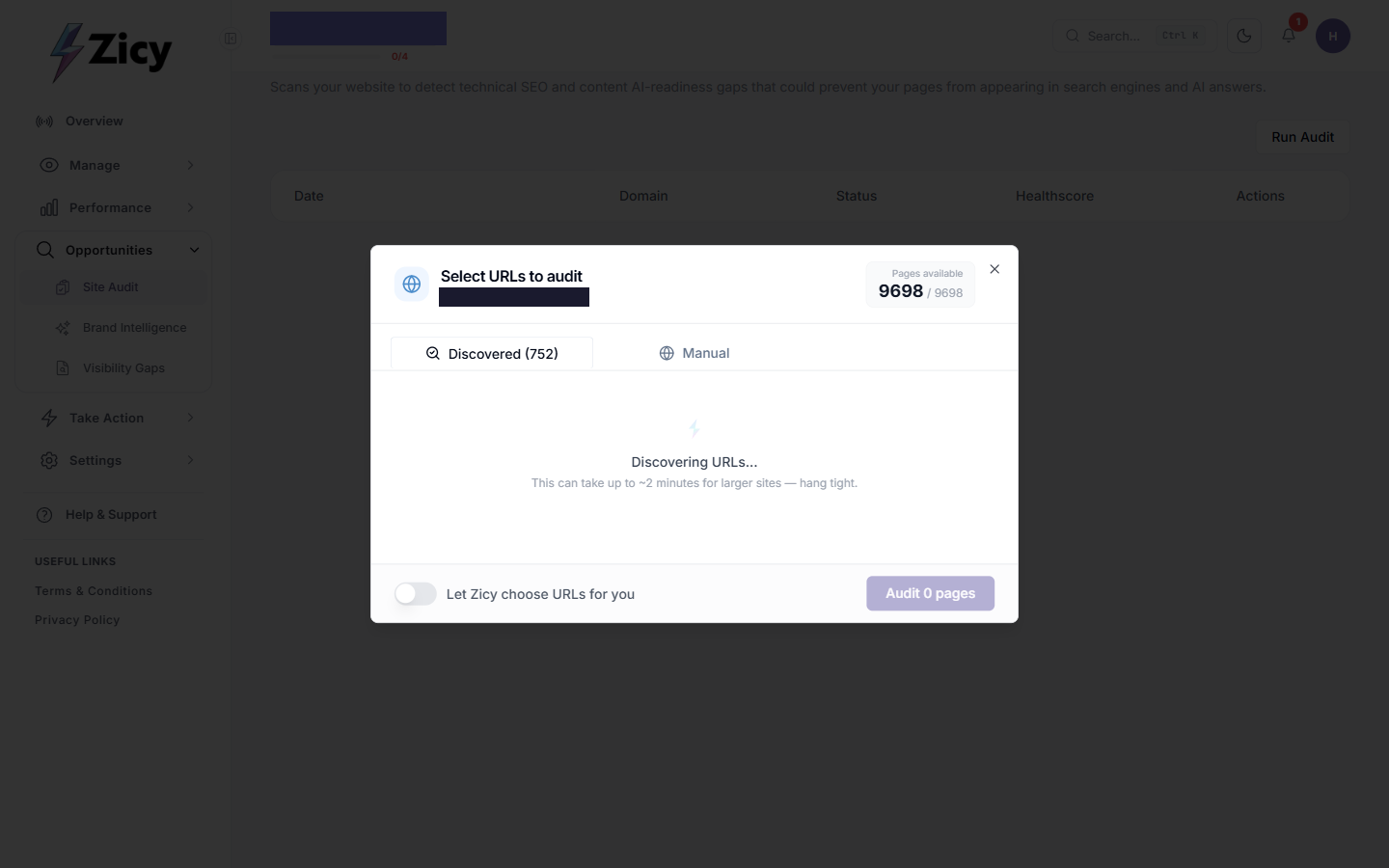
The “Let Zicy choose URLs for you” toggle is the fastest path for a small site.
Step 3: Set up your tracked prompts, and don’t assume auto-generation covers your specialty
Section titled “Step 3: Set up your tracked prompts, and don’t assume auto-generation covers your specialty”Fifteen auto-generated, correctly hyperlocal prompts came back, for example “Which florist provides same-day flower delivery in Kuala Lumpur?” and “What is the best bloom box delivery in Kuala Lumpur?” Because there was no Secondary Location this time, none of the fifteen were flagged “Market mismatch,” a useful contrast to a multi-market business, and confirmation that the mismatch issue is specifically tied to having a secondary market set.
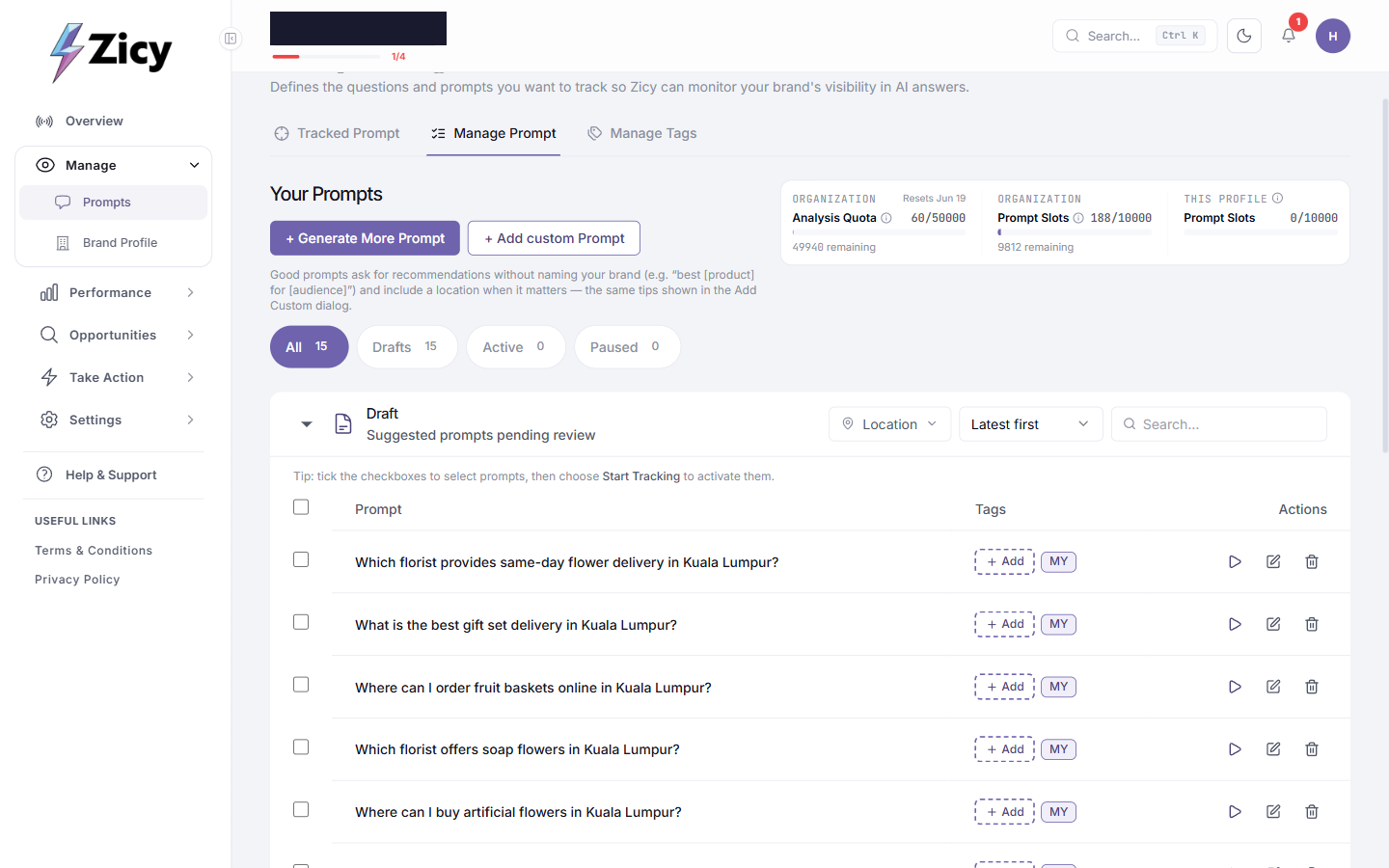
A real finding worth knowing: despite the business’s core differentiator being bridal and wedding florals (it is literally in the site navigation and the USP), none of the fifteen auto-generated prompts mentioned weddings or ROM at all. They were all general product-category queries: bloom boxes, dried flowers, artificial flowers, and so on.
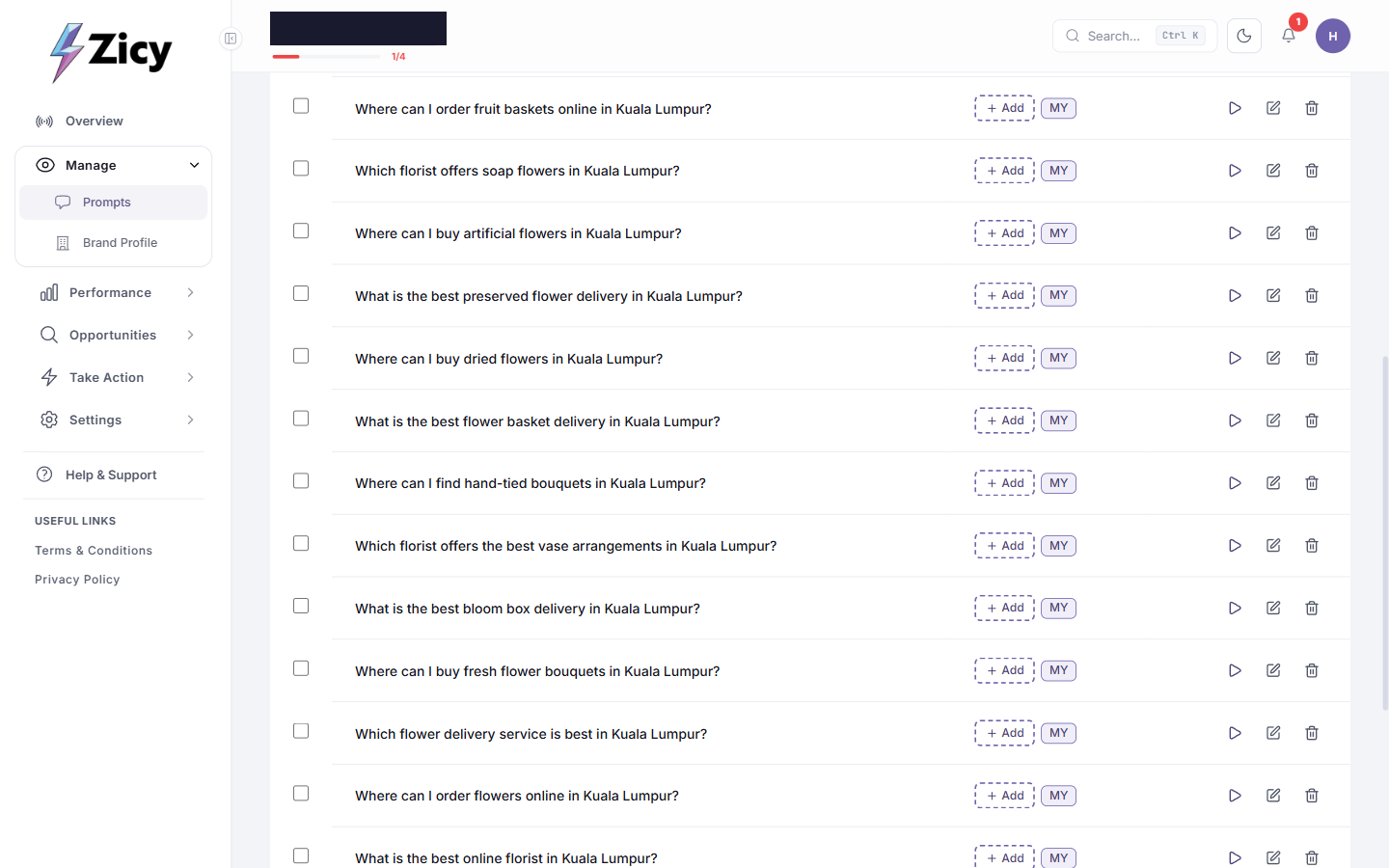
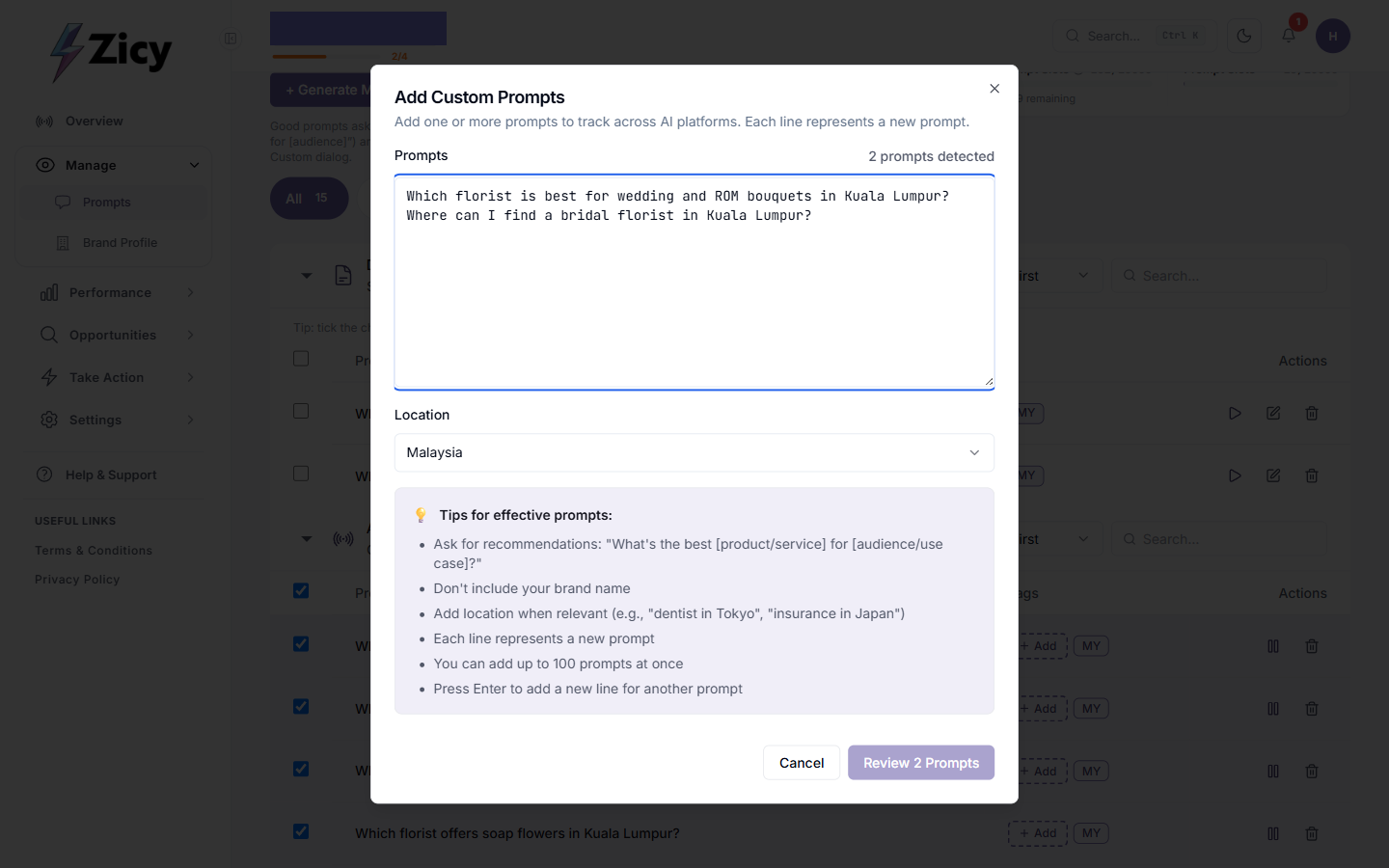
The fix is Prompt Manager’s “+ Add custom Prompt” for anything the auto-generator misses that’s core to the business. Two prompts were added: “Which florist is best for wedding and ROM bouquets in Kuala Lumpur?” and “Where can I find a bridal florist in Kuala Lumpur?” The dialog shows a live “N prompts detected” counter while typing, and gives on-screen tips (ask for recommendations, don’t include your brand name, add a location, up to 100 prompts at once). See how to write tracked prompts that actually work for more on filling gaps like this one.
Step 4: Use the Action Center: get a usable page fast
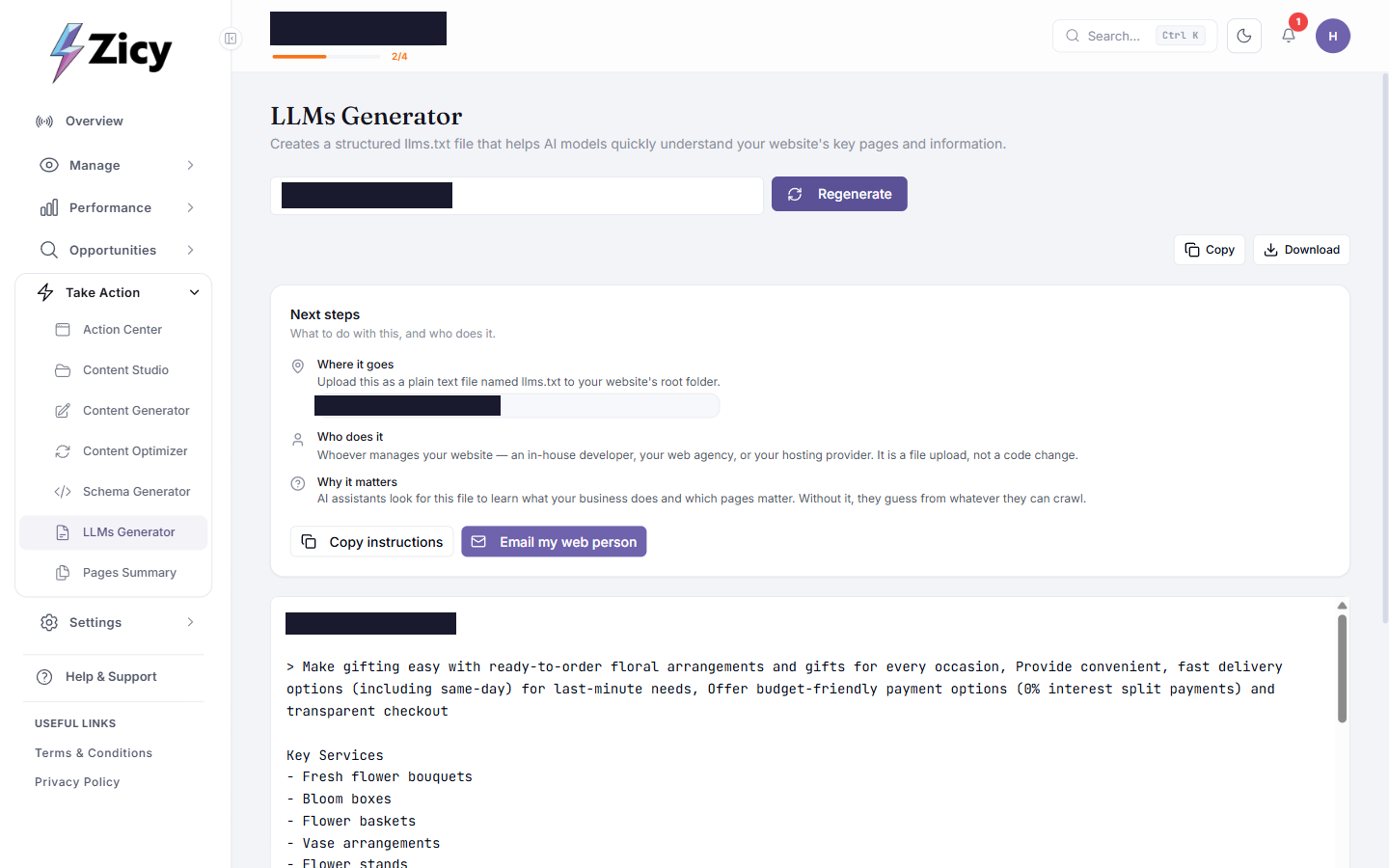
Section titled “Step 4: Use the Action Center: get a usable page fast”With a working sitemap, the LLMs.txt Generator in Action Center generated cleanly with no crawler-blocked warning, a contrast with the exporter’s honest partial-coverage case, and a good example of what the happy path looks like.
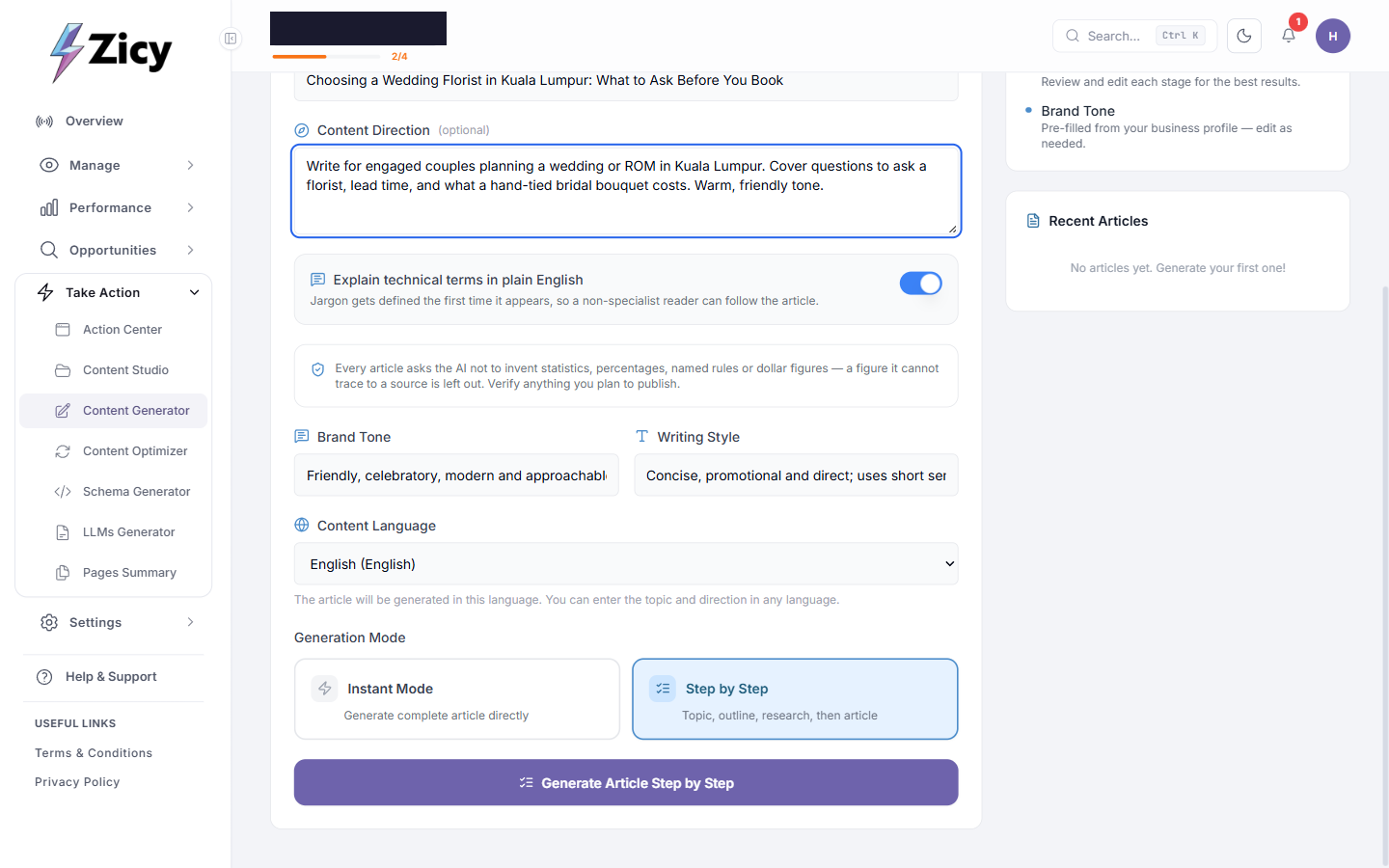
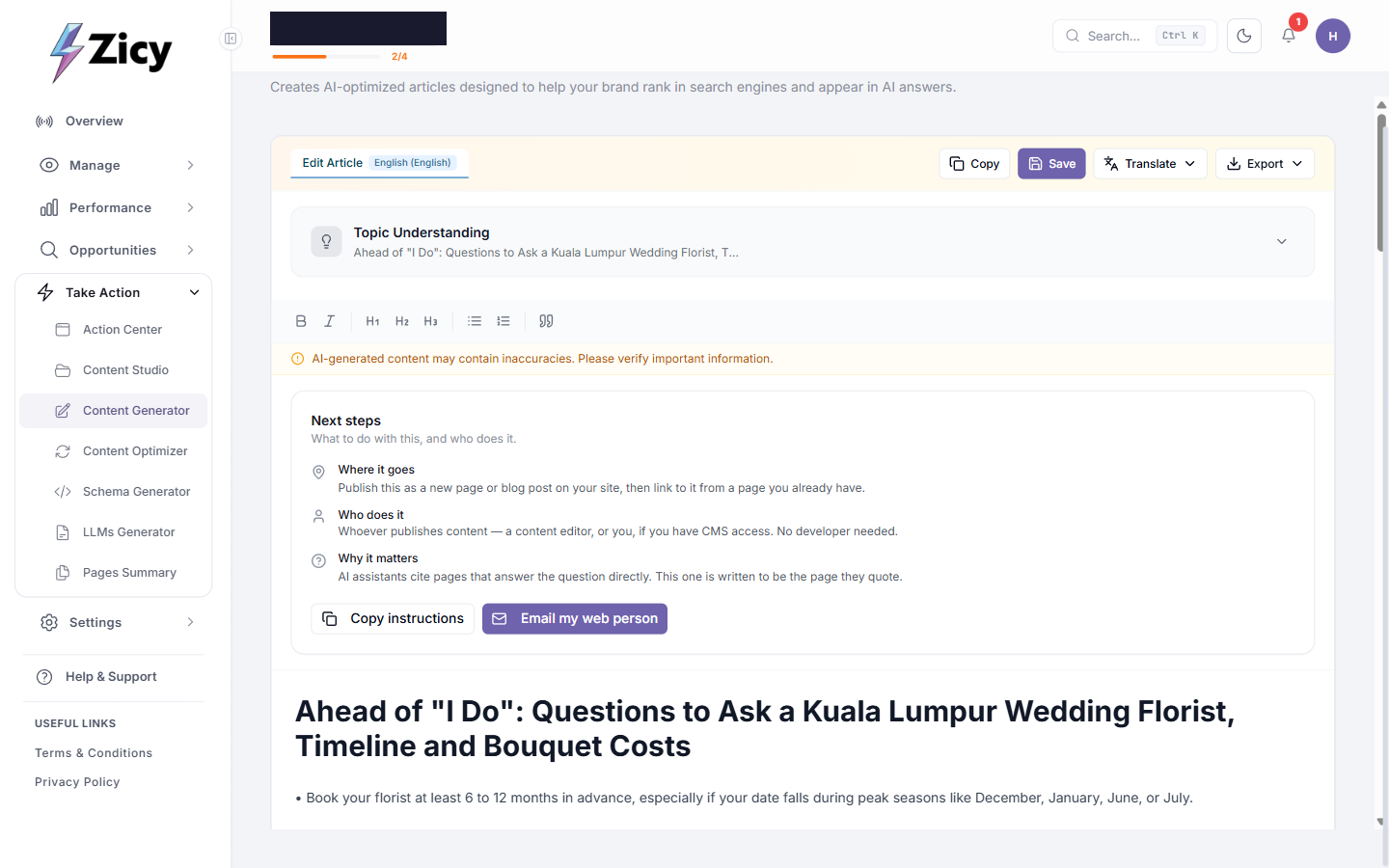
The Content Generator’s Instant Mode is built for a smaller business without time for a four-stage review: it generates a complete article in one shot, roughly forty-five to fifty seconds. A request for “Choosing a Wedding Florist in Kuala Lumpur: What to Ask Before You Book,” aimed at engaged couples in the brand’s own “friendly, celebratory” tone, correctly picked up that voice and delivered a titled, structured, ready-to-edit draft with the same publish-it-yourself disclaimer and “Next steps” guidance as Step-by-Step mode.
When to use which mode: Instant Mode for quick, lower-stakes posts; Step-by-Step mode when you want to review the outline and check real sources before anything gets written, worth it for anything quoting a fact, a price, or a policy.
Step 5: Brand Intelligence: find out what AI actually says about you
Section titled “Step 5: Brand Intelligence: find out what AI actually says about you”The same flow as any other business: Brand Intelligence → Run Analysis, confirming Company Size and competitors, then waiting around five to seven minutes while it queried ChatGPT, Gemini, Perplexity, and Google AI Mode. For this florist, the result was genuinely strong: an AI Perception Score of 87%, a Coverage Score of 88%, and an Alignment Score of 87%, noticeably higher than the exporter’s scores in the companion walkthrough, and a good illustration that a hyperlocal, single-offering business is often easier for AI to describe accurately than a multi-market one.
The Perception Summary read:
“WHAT AI THINKS YOU’RE KNOWN FOR: AI platforms consistently frame Marigold & Thistle Floral Studio as a premium, bespoke florist in Kuala Lumpur, renowned for its ‘quiet luxury’ aesthetic, emotional storytelling through flowers, and reliable same-day delivery in the Klang Valley.
WHAT AI IS MISSING OR GETTING WRONG: AI misses highlighting the brand’s ‘independent, single-location’ aspect as a key differentiator and largely overlooks the ‘budget-friendly payment’ component of its desired positioning, instead emphasizing its premium price point as a potential objection. Offerings like ‘Plants (indoor/outdoor)’ and ‘Subscription/weekly flowers’ are also largely absent from AI responses.“
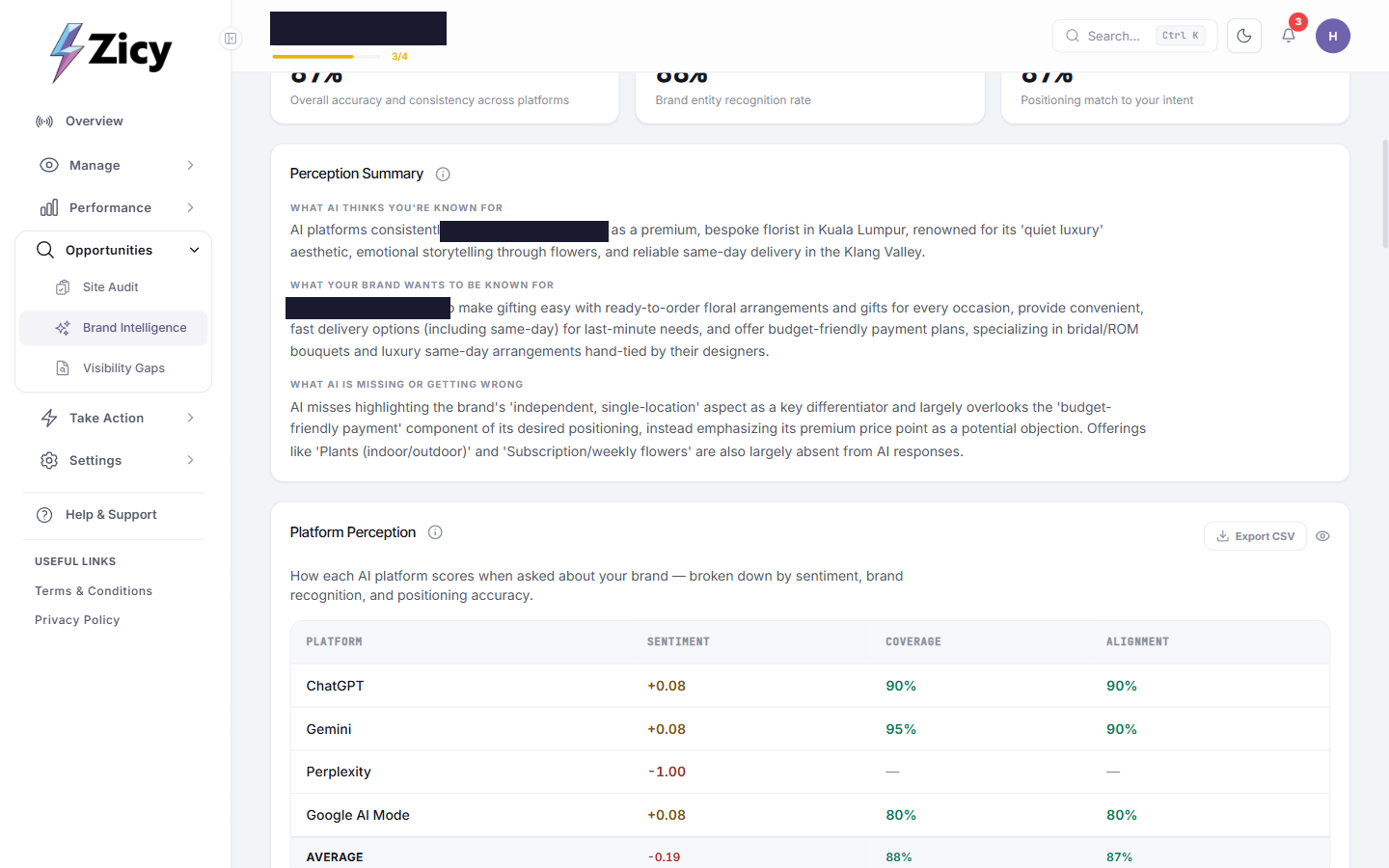
Even at 87% alignment, the module still found something concrete and useful: proof that “we’re independent and single-location,” a strength for trust and local credibility, wasn’t coming through, and AI was treating the premium price point as a weakness rather than the positioning the brand actually wants.
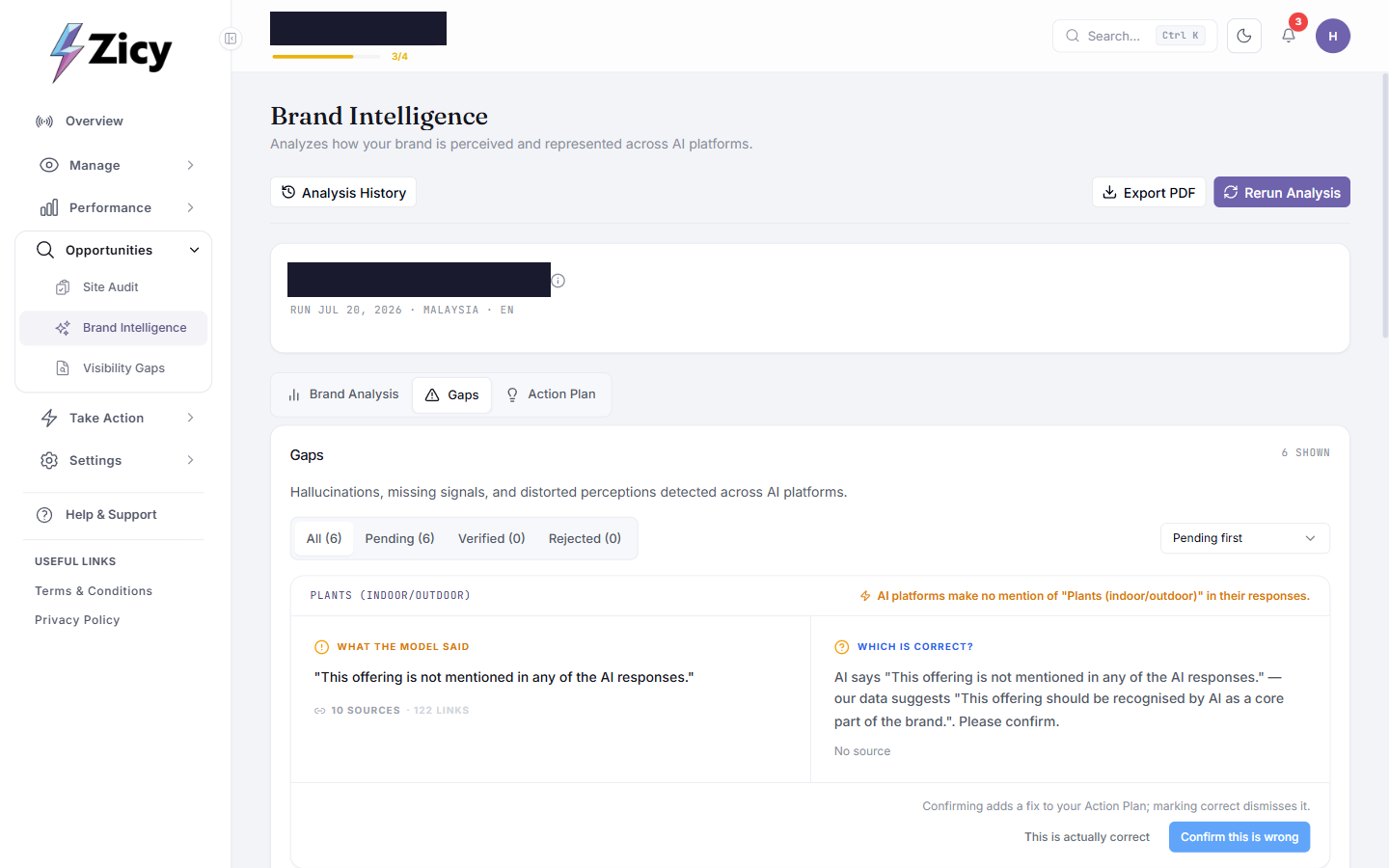
The Gaps tab found 6 gaps, for example: “AI platforms make no mention of ‘Plants (indoor/outdoor)’ in their responses,” with 10 sources and 122 links checked before concluding the offering simply isn’t showing up anywhere.
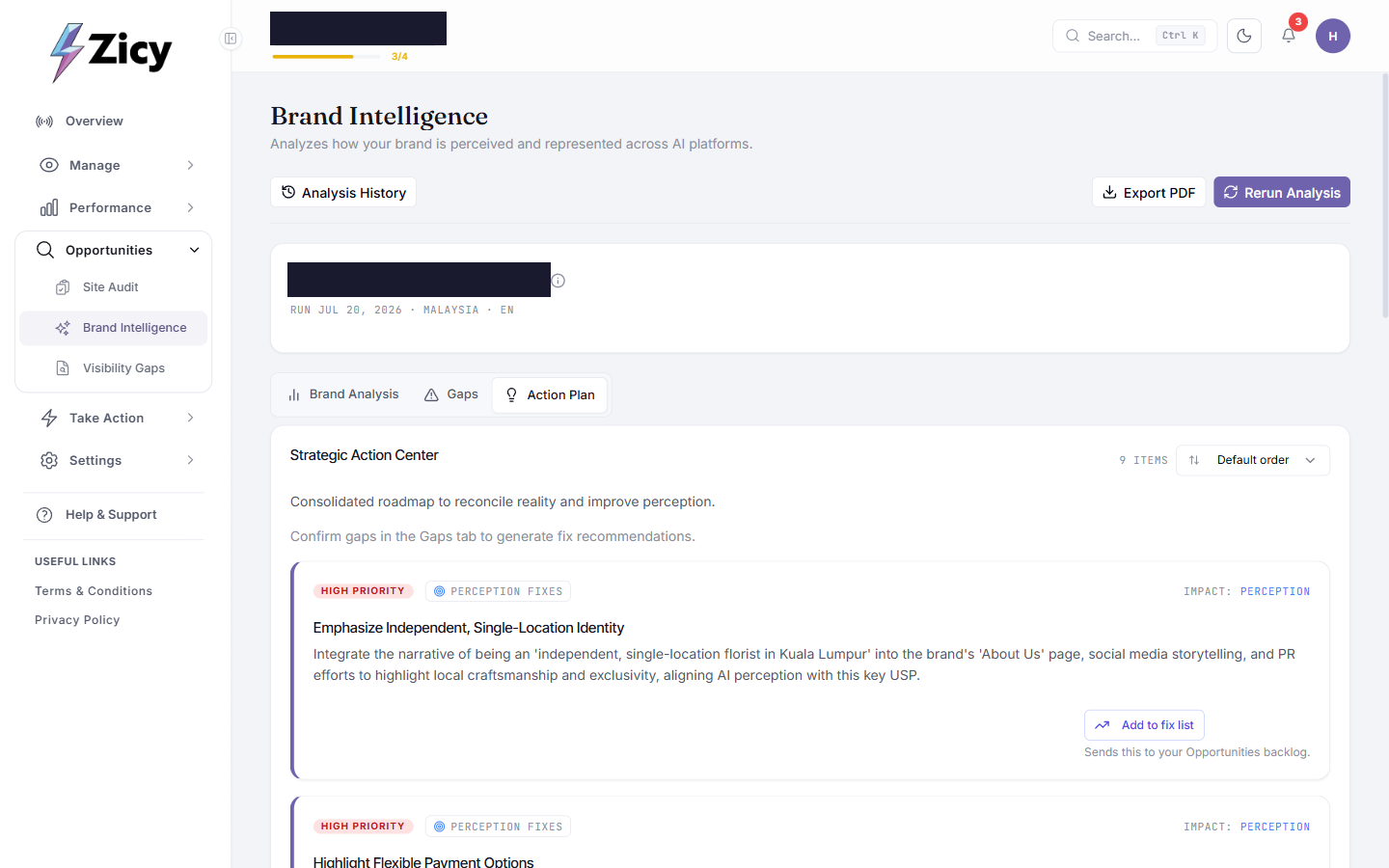
The Action Plan generated 9 items. The top one, directly actionable for a small shop with no marketing team: “Emphasize Independent, Single-Location Identity — Integrate the narrative of being an ‘independent, single-location florist in Kuala Lumpur’ into the brand’s ‘About Us’ page, social media storytelling, and PR efforts to highlight local craftsmanship and exclusivity, aligning AI perception with this key USP.”
What’s next
Section titled “What’s next”- For a hyperlocal business, keep an eye on how AI engines answer “near me” style prompts specifically. That’s where national chains most often crowd out an independent shop, and it’s the gap this walkthrough surfaced most clearly.
- Act on the Action Plan’s top item first, then re-run the analysis in a few weeks to see whether AI’s description of you shifted.
- For the companion walkthrough covering a manufacturer selling both wholesale/export and direct to consumers, see the manufacturers and exporters walkthrough.