Key Topics Analysis
What this is for, in one sentence: Key Topics maps every subject AI platforms associate with your space — showing where AI already features you, where you’re contesting rivals, and where audience demand exists but you’re invisible — so you know exactly what to publish next.
When to come here:
- When planning your content calendar or commissioning stories — this is a demand map written by your actual audience’s AI questions
- When a rival seems to be “everywhere” in AI answers and you want to know on which subjects, specifically
- After publishing into a gap, to check whether AI has started featuring you on that topic
Nadia Rahman runs content at GreenGrid Media, a solar and renewable-energy publication. Her readers increasingly ask AI their questions before they ever reach a publisher — and if AI doesn’t recognize GreenGrid’s coverage on a topic, that audience never arrives. This screen is her commissioning map: what people ask, who AI features, and where the open ground is.
The topic landscape
Section titled “The topic landscape”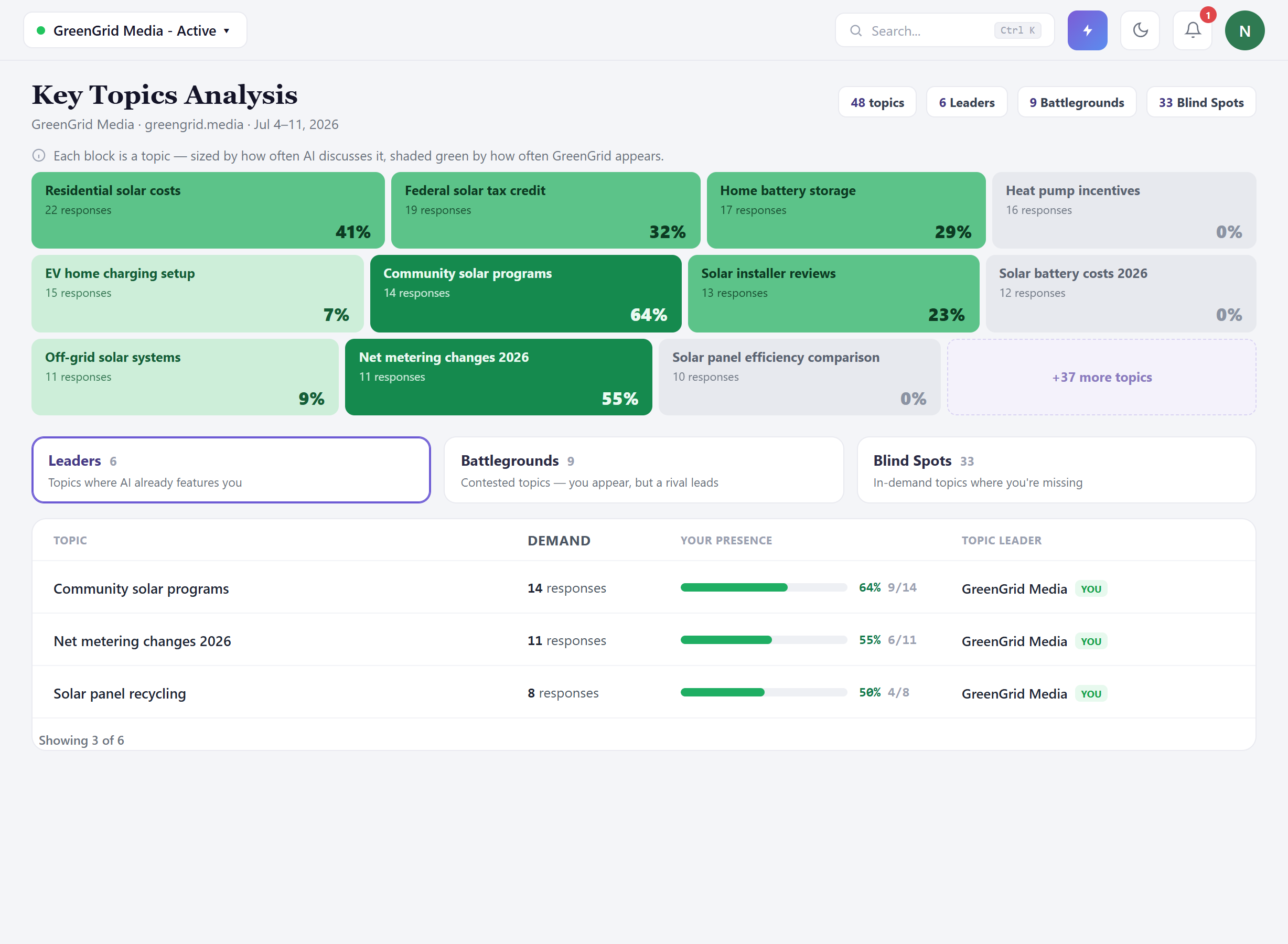 The treemap is your category at a glance: every cell is a topic, sized by demand (how many AI responses touched it) and colored by your presence (how often you appear when it comes up). The green-to-grey contrast is deliberately high so present and absent read apart at a glance — big green cells are your strongholds, big grey cells are the expensive ones, high demand and you’re not in the room.
GreenGrid’s landscape: 48 topics across 72 analyzed responses, sorted into 6 Leaders, 9 Battlegrounds, and 33 Blind Spots. The single biggest cell — residential solar costs, touched by 22 responses — is only 41% GreenGrid’s. The Leaders tab below shows where the brand genuinely owns the conversation: community solar programs (64% presence across 14 responses), net metering changes (55%), solar panel recycling (50%).
Each tier tab carries its plain-language meaning right under the name — a permanent explainer, not a tooltip you have to hunt for: Leaders are topics where AI already features you; Battlegrounds are contested — you appear, but a rival leads; Blind Spots are in-demand topics where you’re missing.
This is your category, not someone else’s. Topics that actually resolve to a different company sharing your name are dropped before they reach the map; genuinely ambiguous ones are badged so you can judge them yourself, and anything set aside is stated rather than silently hidden. What you’re reading is the demand around you.
Honest guidance — demand counts overlap. One AI response usually touches several topics, so demand numbers don’t sum to your response count and shouldn’t be added together. Use demand to rank topics against each other, not as an audience-size estimate.
Battlegrounds: where the fight is live
Section titled “Battlegrounds: where the fight is live”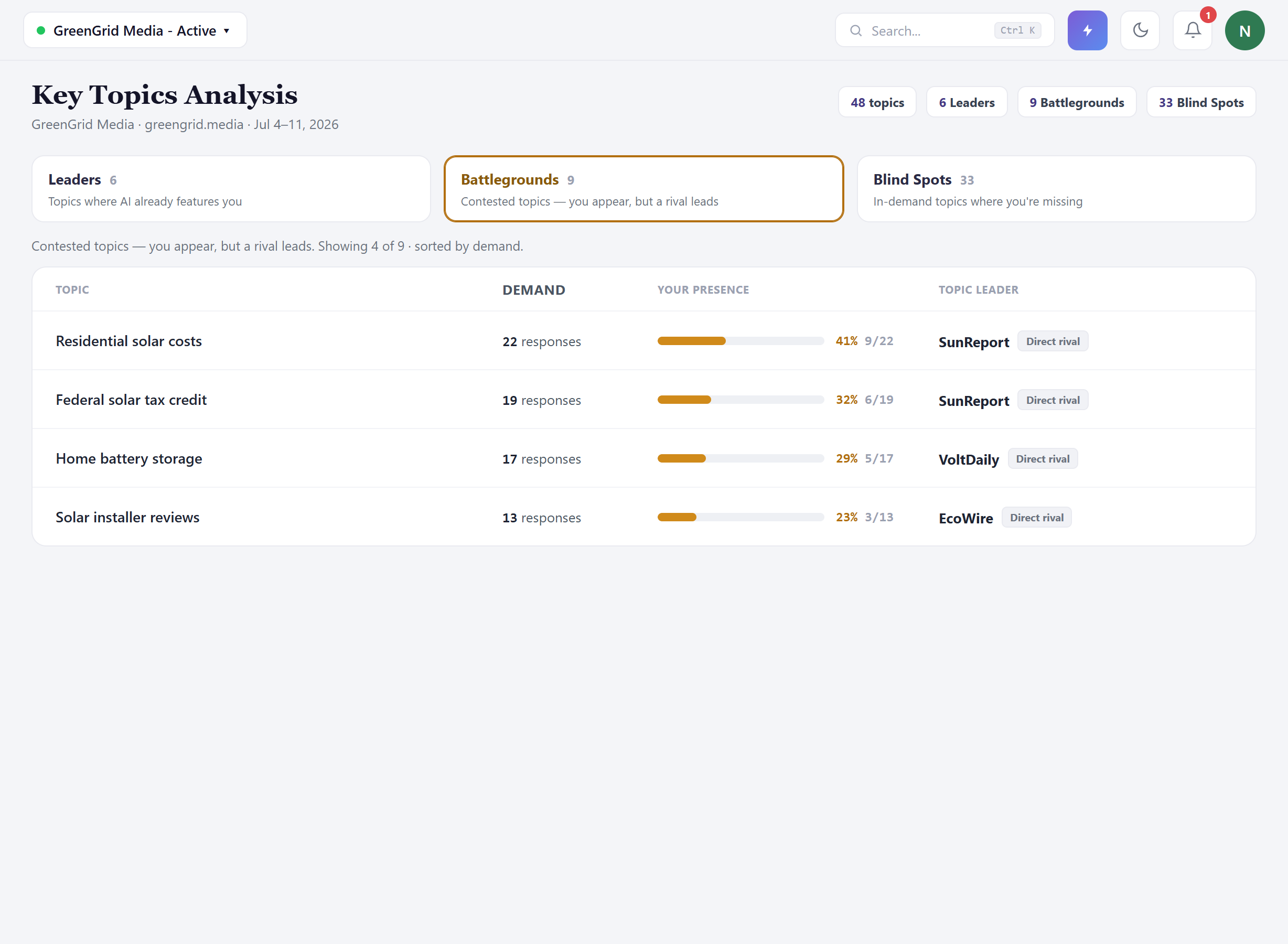 Battlegrounds are the highest-leverage tier for an established publisher, because the entry cost is low — AI already associates you with the topic — and the prize is a leader’s share of the category’s biggest subjects.
GreenGrid’s four visible battlegrounds tell one story: SunReport leads the two largest topics in the entire landscape (residential solar costs, 22 responses; federal solar tax credit, 19), with GreenGrid at 41% and 32% presence respectively. VoltDaily holds home battery storage; EcoWire holds installer reviews. These aren’t gaps to enter — they’re beats to win, and the presence percentage tells you how far from the front you’re starting.
A practical reading order: sort by demand, then ask of each row, “do we have a definitive piece on this, and is it the kind of content AI cites?” A battleground where you’re at 41% with dated coverage is usually a refresh-and-restructure job, not a new commission (see Site Audit and Action Center for the how).
Blind Spots: the commissioning map
Section titled “Blind Spots: the commissioning map”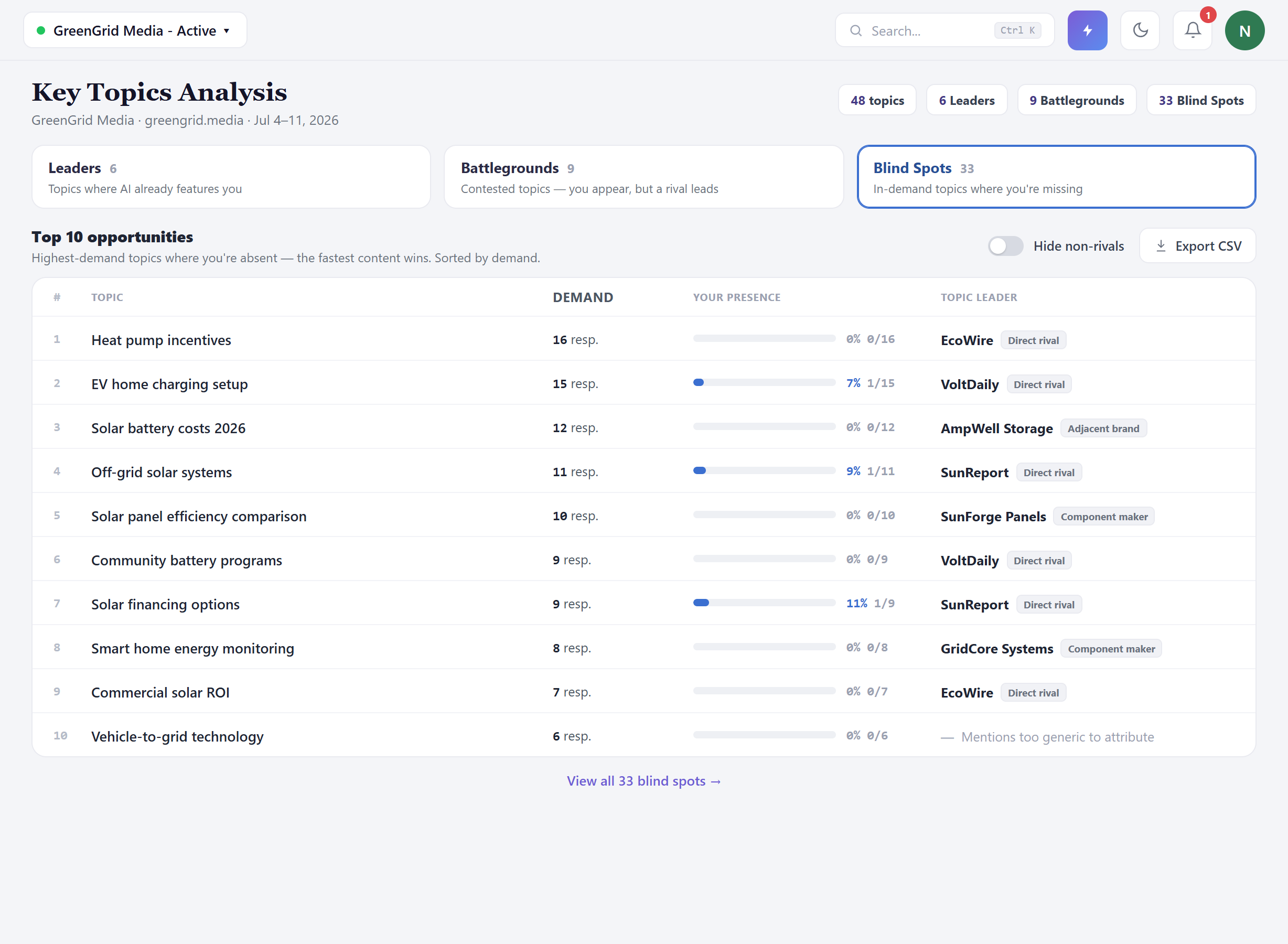 The Blind Spots tab opens on a Top 10 opportunities shortlist — the highest-demand topics where you’re effectively absent — with the full list of 33 one click away. For an editorial team, this shortlist is a ready-made pitch meeting: topic, proven demand, and who currently owns the answer.
Two features of this list do real strategic work:
Leader entity types tell you what kind of gap it is. Each leader is labeled by entity type — direct rival, adjacent brand, or component maker. Heat pump incentives (16 responses, your #1 gap) is led by EcoWire, a direct rival: that’s a straight editorial race you’re losing by absence. But solar panel efficiency comparison is led by SunForge Panels — a manufacturer, not a publication. When a component maker leads a topic, AI is citing product pages because no publisher has written the definitive independent comparison. Those are often the cheapest wins on the board: the incumbent isn’t even playing your game. The “hide non-rivals” toggle lets you filter to pure editorial races when that’s the meeting you’re in — and the leaders you hide stay in the counts, so nothing is silently dropped, just tucked out of view.
Unattributable topics are flagged honestly. Where a topic has real demand but no leader can be attributed — vehicle-to-grid technology, for one — the row says so plainly rather than showing a blank leader cell. The mentions are too generic to credit to anyone; nobody owns it yet. For an ambitious editor, an unclaimed topic with real demand is the best kind of blind spot.
The Export CSV button turns the shortlist into a planning artifact — demand and presence columns intact — ready for your editorial calendar or a commissioning meeting.
Honest guidance — presence lags publishing. Shipping a definitive piece into a blind spot won’t move its presence number for weeks; AI platforms re-crawl and re-weight on their own schedules. Commission from this map monthly, and use the dashboard’s daily, weekly, or monthly trend views to judge results across periods rather than days. Before attributing a presence jump to your new piece, check whether your prompt set changed in the same window — the composition-change trap applies here too.
Honest guidance — don’t chase every cell. Thirty-three blind spots is not thirty-three assignments. The shortlist is demand-ranked, but your filter should be editorial fit: a component-maker-led topic adjacent to your beat may be a better commission than a higher-demand topic outside your authority.
Common questions
Section titled “Common questions”How does a topic end up in Leaders vs Battlegrounds vs Blind Spots? By who leads it and how present you are: topics you lead sit in Leaders, topics where you appear but someone else leads are Battlegrounds, and topics with demand where you’re barely or never present are Blind Spots. Presence is calculated per topic — the share of that topic’s responses in which your brand appears.
Two similar topics used to appear separately. Where did one go? Near-duplicate topics are merged during extraction (e.g. “federal solar tax credit (ITC)” and “30% federal tax credit” are one topic), so demand concentrates instead of splitting across variants. A merged tile notes what was folded into it, so the consolidation is visible rather than something that just quietly happened.
A brand I don’t compete with is listed as a topic leader. Why? Topic leaders are whoever AI features most on that subject — sometimes a manufacturer or adjacent brand rather than a rival publication. That’s information, not an error: it tells you what kind of content currently owns the answer. Use the entity-type label and the hide-non-rivals toggle to read the list the way you need.
Does high demand here mean high search volume? Related but not identical — demand counts how often the topic surfaced across your tracked AI responses, which reflects what people ask AI in your category. It’s the right ranking signal for AI visibility work; pair it with your usual keyword data for total-audience sizing.
We published into a gap — how do I verify AI noticed? Watch the topic’s presence across the next periods — daily, weekly, or monthly on the dashboard’s trend views — and check Citation Analysis to see whether AI has started citing the piece itself. If presence moves but citations don’t, AI is absorbing your angle without crediting you — a different problem worth knowing about.
What to do next
Section titled “What to do next”- Citation Analysis — whether AI actually cites your pages when your topics come up; the recognition layer beneath this map.
- Brand Intelligence — how AI describes your brand and what it gets wrong; Key Topics and Brand Intelligence link to each other, since what AI associates with you shapes which topics you lead.
- Site Audit — if AI can’t read your site properly, no amount of commissioning fixes a blind spot.
- Action Center — draft the definitive piece for a shortlist topic, with sources, ready for editorial review.
- Comparing Yourself to Competitors — the brand-level view of the rivals who keep appearing as topic leaders here.