Citation Analysis
What this is for, in one sentence: Citation Analysis shows whether AI platforms actually credit your site when they answer questions in your space — who gets cited instead, which of your pages AI trusts, and where your reporting is being used without credit.
When to come here:
- To answer the publisher’s core question: when AI talks about our beat, do we get the citation — and the click?
- Before a licensing, syndication, or partnership conversation, to bring a concrete evidence trail of where AI relies on you
- When you suspect AI is using your journalism without crediting it — this is where that suspicion becomes a number
Nadia Rahman’s problem at GreenGrid Media isn’t whether AI answers solar questions — it’s whose work those answers are built on. Every uncredited answer is GreenGrid’s reporting doing the work while someone else (or no one) gets the attribution. This screen turns that from a grievance into a measurable, actionable position.
The headline: who gets credit in your category
Section titled “The headline: who gets credit in your category”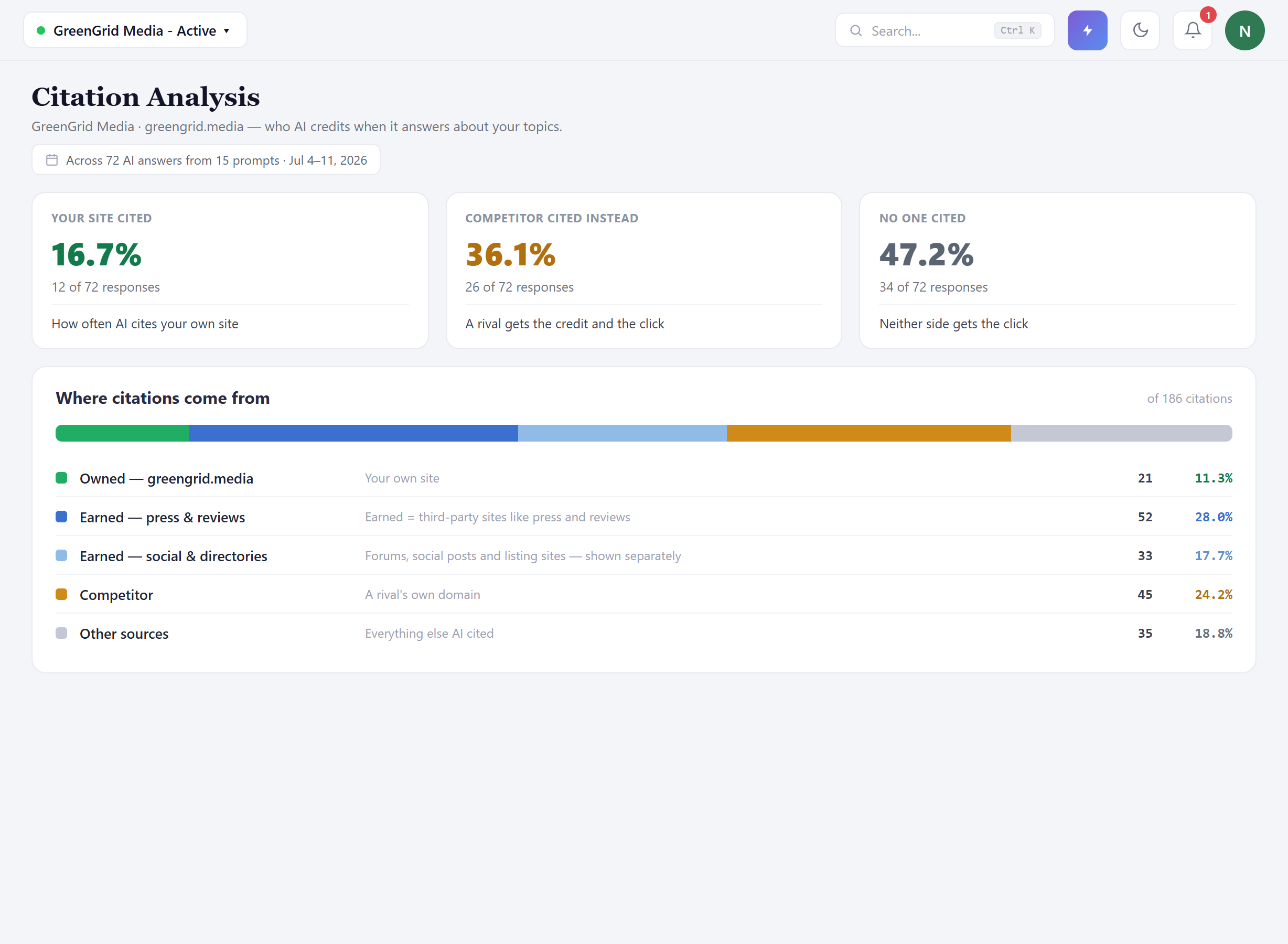 The scope line at the top tells you exactly what you’re looking at — 72 AI answers from 15 tracked prompts this period — and the three cards split those answers by who got cited. That one scope statement governs every number on the screen: there’s a single denominator here, so the cards reconcile with each other and with the source mix below, never contradict them.
Your site cited — 16.7%. In 12 of 72 answers, AI cites greengrid.media directly. That’s the number that becomes traffic, authority, and proof of relevance. It’s the same figure, on the same source and period, as the Web Citation Rate on your AI Visibility Report dashboard — if you ever see the two side by side, they’re measuring the same thing, not two rival definitions.
Competitor cited instead — 36.1%. In 26 answers, GreenGrid isn’t cited but a rival is. This is the sharpest number on the page: more than a third of the time, the question got answered, the credit got assigned — and it went to SunReport, VoltDaily, or EcoWire.
No one cited — 47.2%. Nearly half of all answers credit nobody. This bucket looks passive but isn’t — the analysis below breaks it open.
Read the three together and the strategic picture is blunt: for every answer where GreenGrid gets credit, two credit a rival and nearly three credit no one. That’s the addressable ground.
Below the cards, the source mix shows what all 186 citations across those answers are made of — owned, earned (press and reviews, defined right on the label), social, directory and app-store links as their own segment, competitor domains, and other sources. Splitting social and app-store links out from earned press matters, because a forum or listing link means something very different from a publication citing you. For GreenGrid, competitor domains (24.2%) out-cite owned (11.3%) more than two to one.
Top domains: the trust list — with proof attached
Section titled “Top domains: the trust list — with proof attached”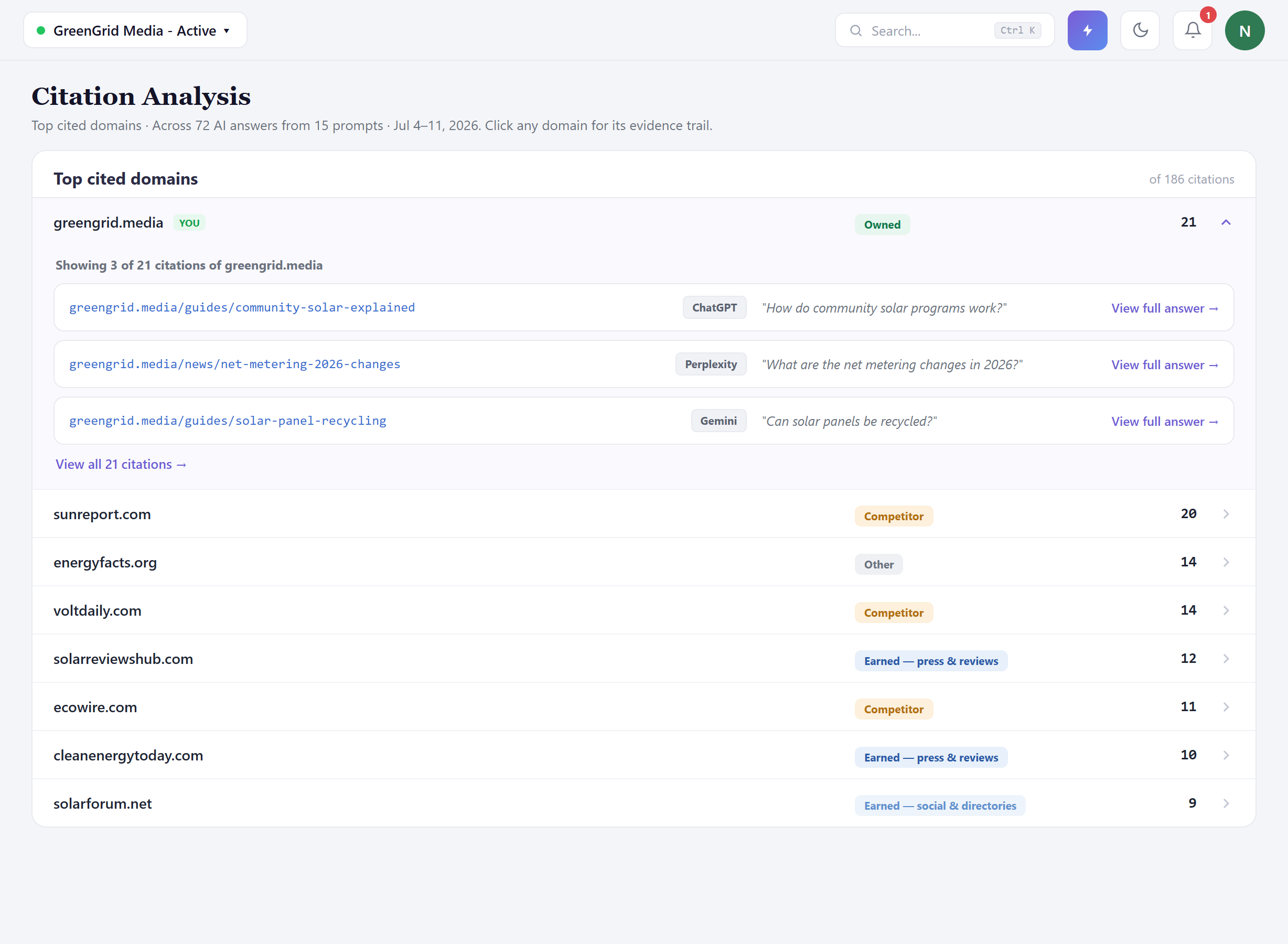 The domain list ranks who AI actually leans on in your category. GreenGrid sits at the top with 21 citations and the YOU badge — but sunreport.com is one citation behind at 20, and the three rivals together hold 45.
This list is scoped to your real brand’s domains. Domains that belong to a different company that happens to share your name are kept out — or flagged when the match is ambiguous — so “the domains AI trusts about you” genuinely means you, not a namesake in another industry.
The feature that changes what this list is for: every domain expands into its evidence. Open your own row and you get the exact cited URL, the engine, the prompt that triggered it, and a link to the full answer — the whole trail is two clicks from this screen. GreenGrid’s three strongest cited pages are its community solar guide, its net metering coverage, and its panel-recycling guide — precisely the topics where it leads the category (see Key Topics Analysis). That’s not a coincidence; it’s the mechanism. AI cites the pages it trusts, and topic leadership follows citation.
Two ways to use the drill-down:
As proof. A screenshot-able trail — “ChatGPT cites this exact page when asked how community solar works” — is the artifact you bring to licensing conversations, partner pitches, and your own board.
As a template. Your cited pages tell you what AI-citable content looks like from your site: structure, depth, specificity. When commissioning into gaps (your Key Topics shortlist), brief writers against your own cited pages, not against generic best practice.
The uncited half — and the number inside it
Section titled “The uncited half — and the number inside it”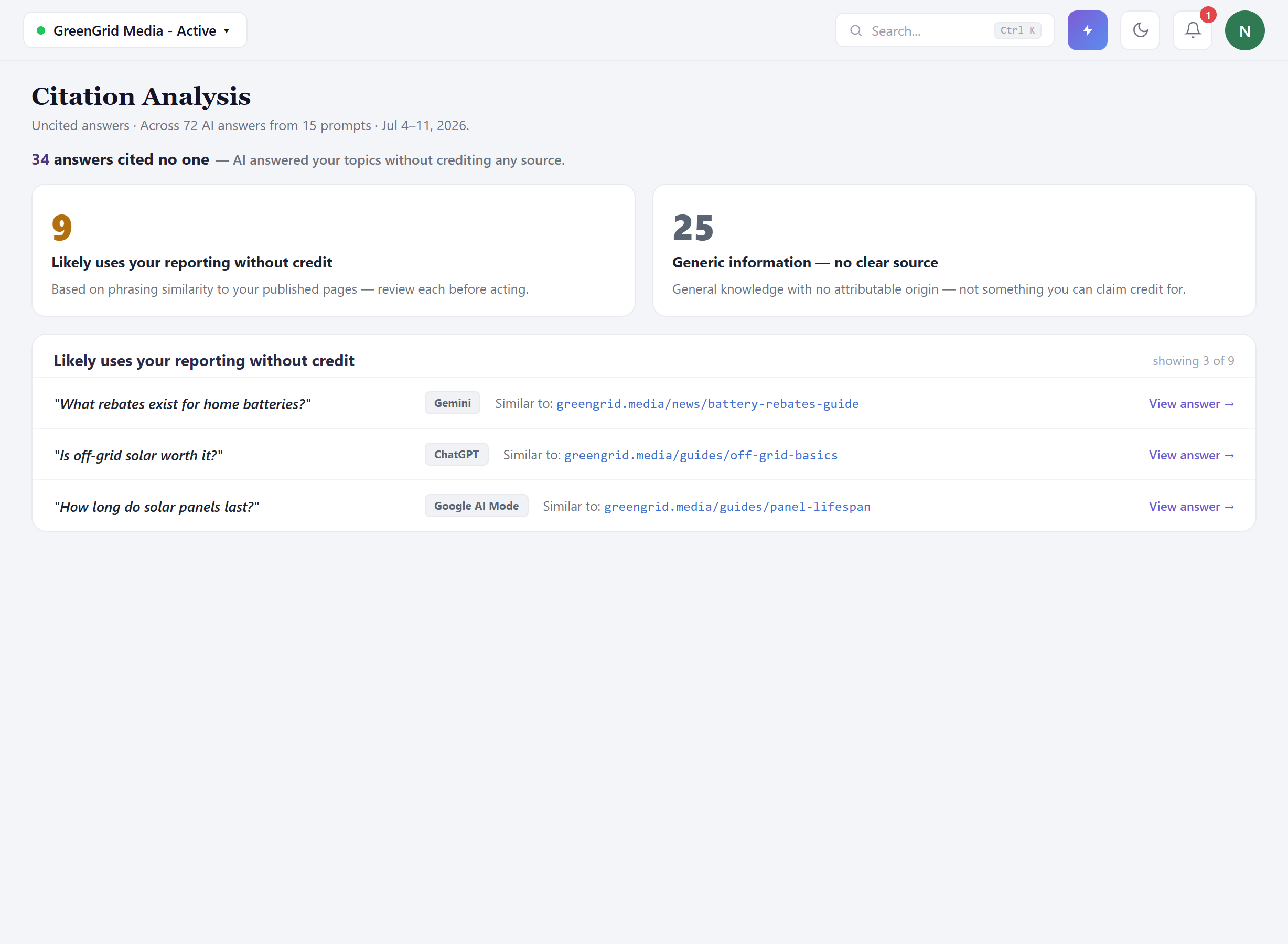 The 34 answers that cited no one split into two very different situations — the “no one cited” bucket is never left as a single flat figure:
“Likely uses your reporting without credit” — 9 answers. These answers’ phrasing closely matches specific GreenGrid pages — your battery-rebates guide, your off-grid coverage, your panel-lifespan explainer — but no citation appears. Each row shows the prompt, the engine, the matched page, and the full answer, so you can judge it yourself.
“Generic information — no clear source” — 25 answers. Commodity knowledge nobody gets credit for. Not your fight.
That first number is the one publishers have never had before: a periodic, per-engine count of probable uncredited use of your work. Nine of 72 answers — one in eight — is a real position in a content-licensing conversation, and a trend line worth watching, whether you view it daily, weekly, or monthly.
Honest guidance — “likely” means likely. The uncredited-use flag is based on phrasing similarity, which is probabilistic. Read each flagged answer against the matched page before you escalate anything externally; a generic overlap and a lifted analysis look different when you see them side by side. Treat the count as a screening signal, the individual rows as the evidence.
Honest guidance — a citation is not a click. This screen measures credit inside AI answers; whether cited links convert into visits is the Site Traffic screen’s job. The two together are your before/after: citations are the leading indicator, traffic the proof.
Honest guidance — the composition-change trap. All three headline percentages share the same 72-response denominator. Add or remove prompts and every number moves without anything changing in the world. Compare like periods.
What to do with each bucket
Section titled “What to do with each bucket”- Grow the 16.7%: your cited pages are the template — structure new and refreshed content the same way, and make sure AI can read it all (Site Audit).
- Attack the 36.1%: expand a rival’s domain row to see exactly which of their pages win citations on which prompts — then commission or upgrade your answer to those specific questions (Key Topics, Action Center).
- Work the 9: strengthen the machine-readable link between your reporting and your identity (schema, llms.txt via Action Center), and keep the evidence trail — it compounds into leverage.
Common questions
Section titled “Common questions”Why does a rival get cited on a topic we cover better? AI cites what it can read, parse, and trust — recency, structure, and machine-readability often beat editorial quality. Check the rival’s cited page via the drill-down, then check your equivalent page in Site Audit: the gap is usually technical or structural, not journalistic.
Do citations from social, directory, and app-store links matter? They’re segmented separately because they mean something different: a forum or listing link is AI reaching for any source, not an authority judgment. Watch the earned press-and-reviews segment for earned authority, and your owned share for direct credit.
We’re cited but traffic didn’t move. Is it worth anything? Citation share is the leading indicator — it builds the authority loop that compounds into presence and, over time, referral traffic. Verify the traffic side in Site Traffic; if citations rise for months with zero referral movement, the issue is usually which pages get cited (deep guides vs. clickable news).
Can we stop AI from using our content uncredited? You can’t unilaterally stop it, but you can shift it: make attribution easy (clear entity signals, schema, llms.txt), make your pages the citable version of the story, and use the evidence trail in licensing or partnership discussions. The 9-count and its rows are your negotiating file.
How often should I check this? Watch the three headline numbers each period — the dashboard’s daily, weekly, and monthly views let you pick the grain — and the domain list monthly. Check immediately after publishing a major investigation; that’s when uncredited use is most likely and most costly.
What to do next
Section titled “What to do next”- Site Traffic — the click side of the citation story; proves whether credit becomes visits.
- Key Topics Analysis — where to aim: the demand map this screen’s credit map sits under.
- Site Audit — if AI can’t parse your pages, rivals win citations on structure alone.
- Action Center — schema, llms.txt, and citable content drafts to grow the owned share.