Competitor Sentiment Profiles
What this is for, in one sentence: Competitor Sentiment Profiles shows how AI platforms talk about each of your rivals — their tone score, their positive and negative descriptors — so your own sentiment score has context and your positioning has targets.
When to come here:
- Right after reading your own Brand Sentiment, to turn “we’re a 72” into “we’re the warmest brand in the category” — or a warning
- Before positioning work, messaging, or a competitive pitch, to find the words AI attaches to rivals that you can attack or avoid
- When a competitor’s marketing push is underway and you want to know whether it’s changing how AI describes them
Priya Nair has MenuPilot’s own sentiment in hand: 72, positive, improving. Her next question is the one leadership will ask: compared to what? This module answers it — and hands her the competitive vocabulary AI is already using.
The overview: your category’s tone map
Section titled “The overview: your category’s tone map”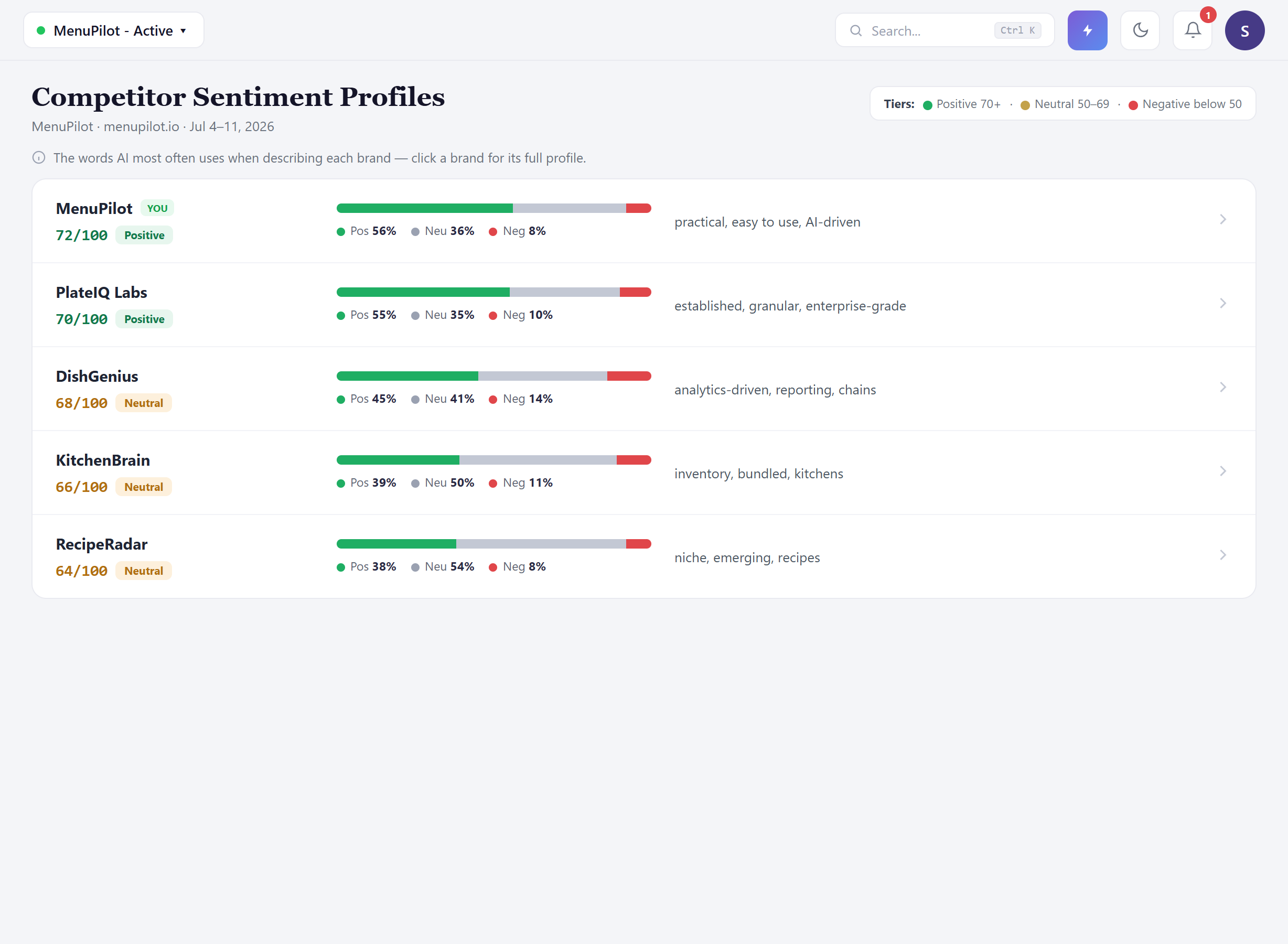 Every tracked brand appears with its sentiment score, its tier, its positive/neutral/negative split, and the three words AI most often reaches for. Your own brand carries the YOU badge, ranked among them.
Every one of these scores is built the same way your own is — same source responses, same 0–100 scale, same band thresholds as Brand Sentiment. That’s what makes the comparison trustworthy: a rival’s 70 means precisely what your 72 means, so the numbers reconcile whichever screen you read them on.
The MenuPilot picture: 72/100 — the warmest score in the category, just ahead of PlateIQ Labs at 70, with DishGenius (68), KitchenBrain (66), and RecipeRadar (64) all sitting in Neutral. The tier legend on screen tells you where the lines are: Positive starts at 70, so this is a two-horse race for warmth with three brands AI simply doesn’t feel strongly about.
Read the splits, not just the scores. MenuPilot and PlateIQ have nearly identical positive shares (56% vs 55%) — the gap between a 72 and a 70 is real but thin. Meanwhile KitchenBrain’s story is dominated by neutrality (50% of its mentions are flat), which is a different competitive situation from DishGenius, whose 14% negative share is the highest in the category. Same tier, different problems.
Each profile is pinned to the right company, too — Zicy resolves rivals by entity, so a competitor that shares a name with an unrelated business doesn’t get a stranger’s tone folded into its profile. What you read for PlateIQ Labs is PlateIQ Labs.
The drill-down: a rival’s full profile
Section titled “The drill-down: a rival’s full profile”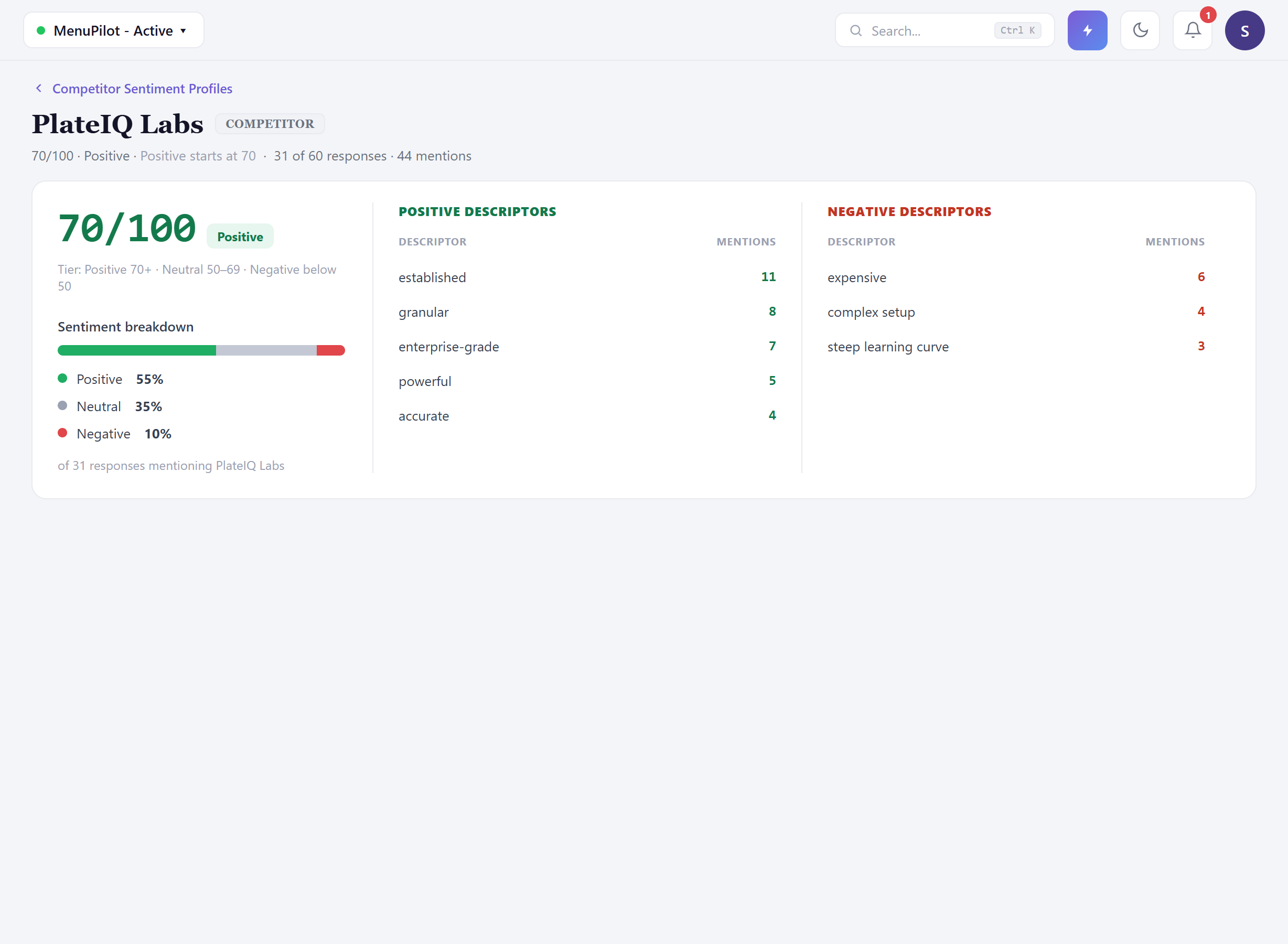 Open any competitor for the full profile. PlateIQ Labs — your closest rival on every metric — reads: established (11 mentions), granular (8), enterprise-grade (7), powerful (5), accurate (4) on the positive side; expensive (6), complex setup (4), steep learning curve (3) on the negative.
This is the most strategically loaded screen in the module, because AI has already written the category’s positioning map for you:
PlateIQ’s negatives are MenuPilot’s positives, almost word for word. AI calls PlateIQ expensive and complex; it calls MenuPilot affordable and easy to use. That contrast isn’t something you need to manufacture — it already exists inside AI answers, which means content that sharpens it (“powerful without the enterprise price tag”) pushes on an open door. Conversely, PlateIQ owns established and enterprise-grade — words a younger brand shouldn’t contest head-on.
A rival’s negative descriptor is your sales-enablement material. Six mentions of expensive across PlateIQ’s coverage means prospects asking AI about the category are routinely told your main rival costs more. Your pricing page, comparison content, and sales narrative should make that comparison effortless to complete.
Watch descriptors move, not just scores. A competitor’s score drifting two points is noise; a new negative descriptor appearing — or one of yours migrating onto their profile — is a narrative shift worth investigating at the source.
Honest guidance — descriptor counts are occurrences, not responses. Counts tally how often a theme appears across a brand’s mentions, so they won’t reconcile with the polarity split and don’t need to. Use them to rank themes and track movement between periods.
Honest guidance — the composition-change trap applies to rivals too. A competitor’s split is computed over the responses that mention them. If your prompt set changes, every brand’s numbers move together — check your own composition before reading meaning into a rival’s shift.
Turning profiles into work
Section titled “Turning profiles into work”- Pick your contrast rival. Usually the brand adjacent to you in score with opposing descriptors — for MenuPilot, that’s PlateIQ. Build comparison content around the descriptor contrast AI already believes.
- Claim the unowned words. Scan all five profiles for valuable descriptors nobody owns (accurate appears only weakly; nobody owns proven ROI). Whitespace in the descriptor map is cheap to claim.
- Defend your own. Your positive descriptors (see Brand Sentiment) are assets rivals can erode. If a competitor starts accumulating easy to use, your differentiation is being contested inside AI answers.
- Route fact-shaped problems to Brand Intelligence. If a rival’s profile — or yours — contains a descriptor that’s factually wrong rather than perceptual, that’s a truth problem: verify and fix it at the source rather than fighting it with messaging.
Common questions
Section titled “Common questions”A competitor’s score looks wrong compared to what I know about them. Why? The score reflects how AI platforms talk about them — which lags reality and follows citable content, not insider knowledge. It’s not a mix-up with a same-named company, either: profiles are resolved by entity, so you’re reading the right rival. If they’re genuinely better (or worse) than AI says, that gap is information — it tells you how much narrative room exists in the category.
Can competitors see that I’m tracking them? No. Profiles are built from AI platform responses to your tracked prompts — there’s no interaction with the competitor.
Two rivals have the same tier — are they equivalent? Check the split and the descriptors. A neutral-heavy profile (nothing vivid to say) and a polarized profile (loved and criticized) can carry the same tier label and demand opposite competitive strategies.
Which competitors appear here? Your saved competitor set — the same editable list that drives the competitive table. Review it or add and remove rivals from setup or the competitive screen, and both screens stay in step.
How often should I review this? Monthly for descriptor movement; immediately after any rival’s major launch, funding news, or PR push. When you want to see how a rival’s tone is trending rather than a single snapshot, the dashboard’s Performance Trends panel now offers daily, weekly, or monthly views.
What to do next
Section titled “What to do next”- Brand Sentiment — your own profile; read the two side by side for the full tone map.
- Comparing Yourself to Competitors — the metric view (coverage, ranking, share of voice) that pairs with this tonal view.
- Key Topics Analysis — which subjects each brand is associated with; descriptors tell you how AI talks, topics tell you where.
- Action Center — build the comparison and positioning content the descriptor map points to.