Per-Prompt Results
What this is for, in one sentence: this is where you open a single tracked prompt and read the actual AI answers behind your numbers — the ground truth every dashboard metric is built from.
When to come here: whenever a number surprises you (“why did coverage drop?”), when you want the exact wording AI uses about you, or when you need evidence for a report. Dashboards summarize; this screen shows receipts.
We follow Sarah at MenuPilot, opening her prompt “Which software helps restaurants price menu items?”
The per-engine breakdown
Section titled “The per-engine breakdown”Opening a prompt shows how each of the five AI platforms answered the same question — because they rarely agree.
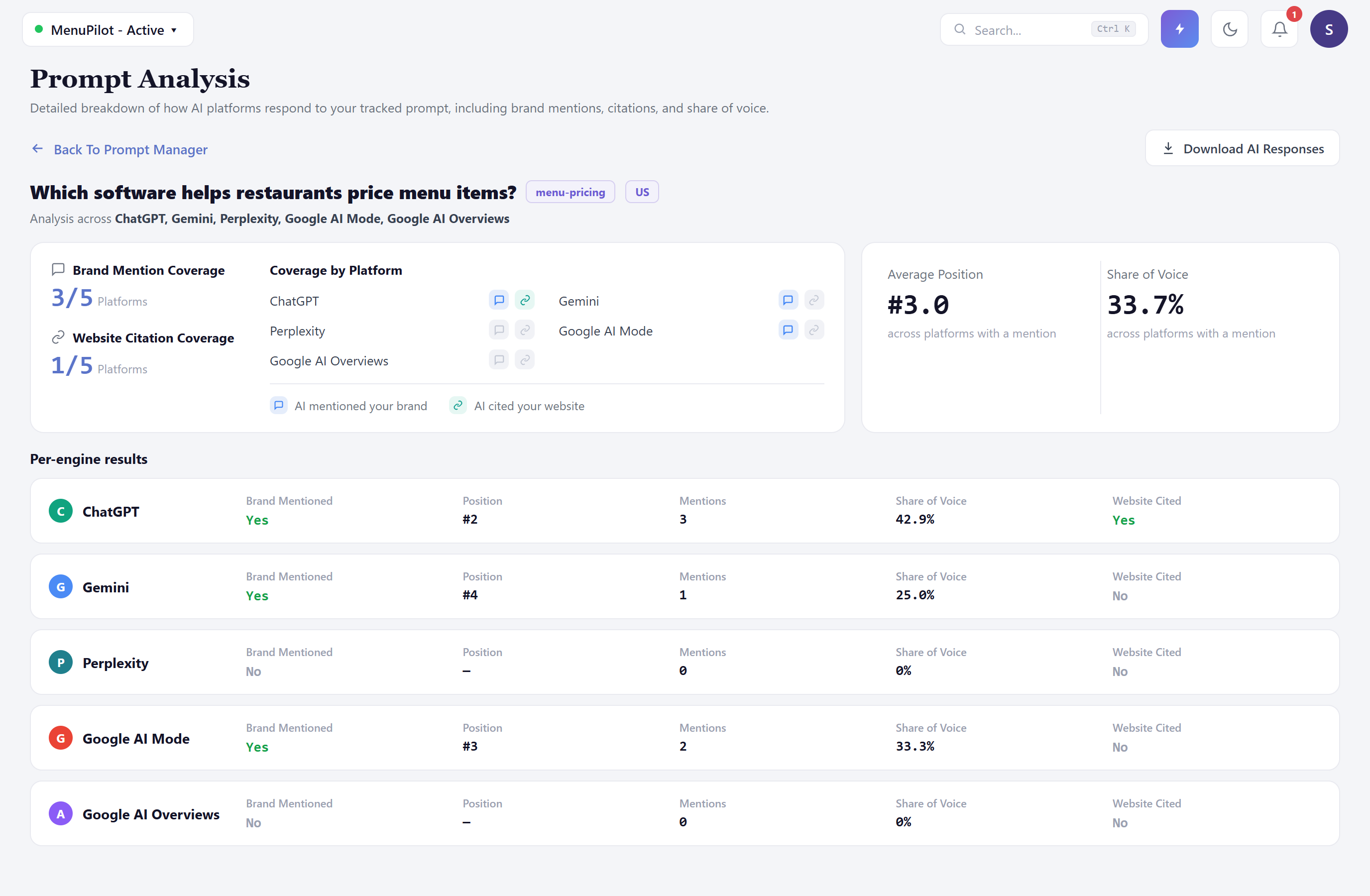
For each engine you get five facts:
- Brand Mentioned — whether your brand was named, and how prominently. This isn’t just a blunt Yes/No: a single mention buried deep in an answer is labelled as the low-prominence mention it is, rather than turning a triumphant green “Yes” that reads like an endorsement.
- Position — where you appeared in the recommendation order. #2 means second brand named.
- Mentions Frequency — how many times your name came up in that answer.
- Share of Voice — your share of all brand mentions in that one answer.
- Website Cited (Yes/No) — did the answer link to your site.
Sarah’s spread is typical: strong on ChatGPT (#2, cited), barely present on Gemini (#4, one mention), absent from Perplexity and AI Overviews entirely. Per-engine differences like this are normal — each platform draws on different sources. They tell you where to focus, which is exactly the point.
Reading prominence, not just presence
Section titled “Reading prominence, not just presence”The important habit on this screen is to read how strongly you show up, not just whether you show up. Being named once at the bottom of an answer a rival dominates is a very different result from being a headline recommendation — and Zicy now reflects that difference in the Brand Mentioned label itself, so a technical presence no longer masquerades as a win.
To judge a result fully, read three columns together:
- Brand Mentioned — are we in the conversation, and how prominently?
- Position — are we a headline recommendation (#1–2) or an afterthought (#4+)?
- Mentions Frequency — did the answer discuss us, or name-drop us once?
Sarah’s Gemini result (#4, 1 mention) is a presence, not an endorsement — and it’s labelled as the low-prominence mention it is. Her ChatGPT result (#2, 3 mentions, cited) is a real win. The screen makes the gap between the two legible instead of flattening both into the same green tick.
Reading the full answer
Section titled “Reading the full answer”Click into an engine to read its complete answer — the exact text a real buyer saw. The answer text is shown clean, exactly as the buyer would read it — no raw citation tokens or markup cluttering the prose.
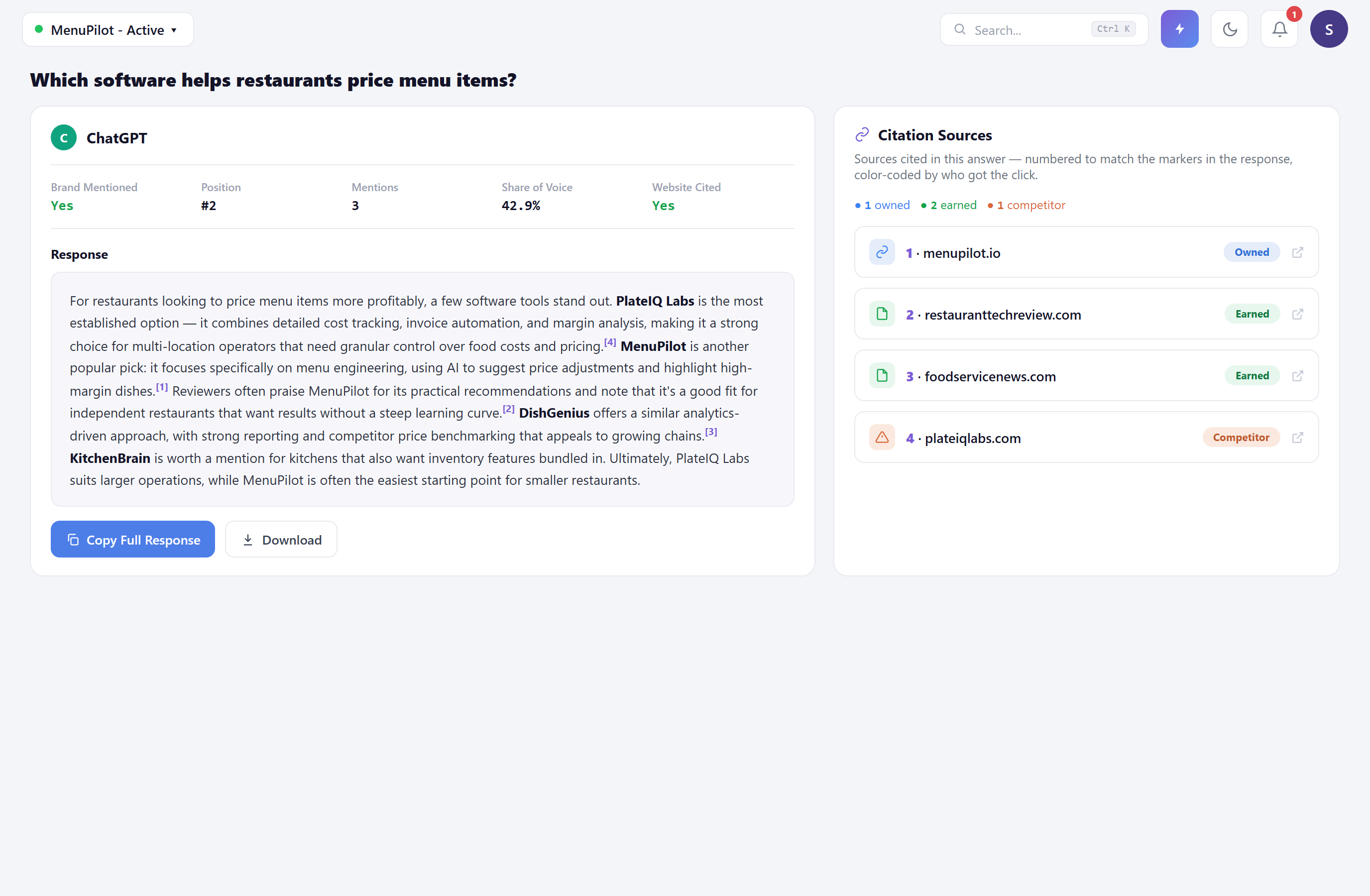
Three things to do here:
- Read how you’re framed, not just that you appear. “MenuPilot is a good fit for independent restaurants” and “MenuPilot also exists” both count as mentions; only one wins customers. This framing is what the Sentiment module measures at scale — here you see the raw material.
- Read who’s framed better. The brand described first, longest, and most concretely is winning this answer. What is AI saying about them that it isn’t saying about you?
- Check the Citation Sources list — the color-coded list of every site this answer drew on: your own site (owned), third-party sites (earned), or rivals’ sites (competitor). If an engine consistently leans on one review site, that site is where your category’s answers are being decided. (The full source-type breakdown across all prompts lives in Citation Analysis, M-10.)
Copy Full Response / Download — use these to pull exact quotes into reports or share an answer with your team. What you copy or download is exactly the clean text shown on screen, so quotes paste in ready to use. Quoting AI verbatim is far more persuasive to a boss or client than any chart.
The ranked Brand Mentions list
Section titled “The ranked Brand Mentions list”Below the answers sits the leaderboard for this prompt: every brand named across the engines’ answers, ranked by mention count.
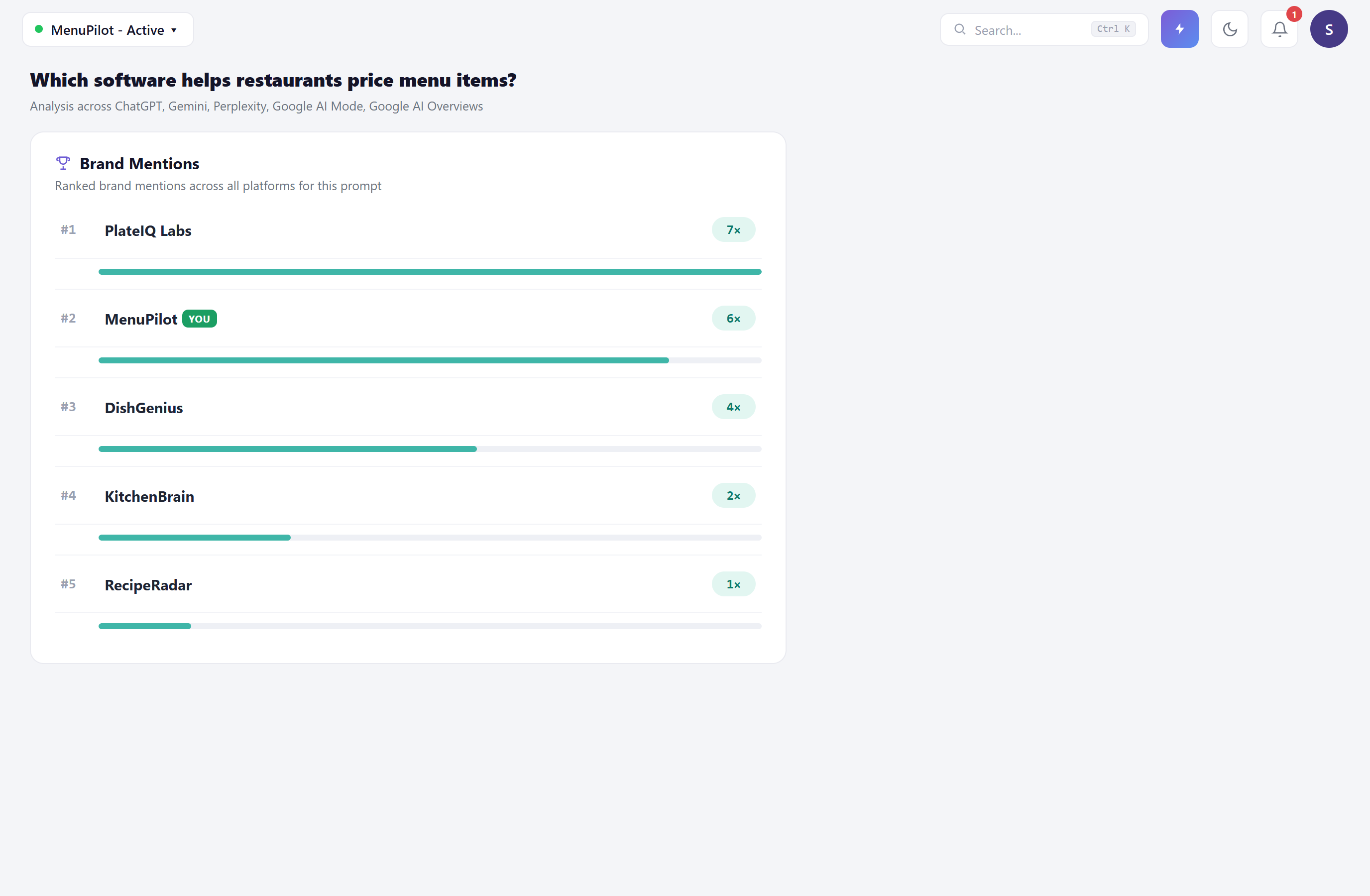
This is the fastest way to see who dominates a specific question. Sarah’s list shows PlateIQ Labs at #1 with 7 mentions to her 6 — close, which makes this prompt a genuine battleground worth fighting for.
Finding yourself in the list. Your own brand carries a green YOU badge, so a mention count next to a look-alike name can’t be mistaken for yours — and look-alike brands display their domain so you can tell them apart. If a name you don’t recognise appears, open the full answer to see the context.
Common questions
Section titled “Common questions”Why is my brand on some engines and not others? Each platform learns from different sources and updates at different times. Absence on one engine is a targeting insight, not a malfunction — see which sources that engine cites and earn your way into them.
An answer names a brand I’ve never heard of — why? AI answers reflect the market as AI sees it, which includes small players, adjacent tools, and occasionally brands from neighbouring categories. The Competitive AI Performance module (M-05) is where you decide who’s worth formally tracking.
Can I share one answer with a colleague? Yes — Copy Full Response for pasting, or Download for the file. The exported client report (M-15) also includes tracked-prompt results in summary form.
The answer text mentions us but Website Cited says No — contradiction? No: being named and being linked are different events. That gap — famous but never cited — is common, and closing it is what the Citation Analysis and Action Center modules are for.
What to do next
Section titled “What to do next”- Zoom out to the scoreboard these answers roll up into: AI Visibility Dashboard (M-04).
- See mentions by brand across ALL prompts: Competitive AI Performance (M-05).
- Understand who gets cited and why: Citation Analysis (M-10).