Brand Sentiment
What this is for, in one sentence: Brand Sentiment reads the tone of what AI says when it mentions you — one score with an honest scale, and the exact words, positive and negative, that AI reaches for when describing your brand.
When to come here:
- After Brand Intelligence has the facts right — this is the layer above the facts: how it sounds
- Before writing positioning or comparison content, to know the vocabulary AI already uses about you
- Periodically, because tone drifts as new sources enter the answers
Brand Sentiment has its own spot in the left nav, so you can jump straight to the tone read without going through the wider dashboard.
Priya Nair can’t interview every AI answer her buyers read, but she can read the summary of all of them: the words that keep coming up. Some of them she’d put in MenuPilot’s own copy. A couple of them she needs to make go away — and one of those, it turns out, isn’t a tone problem at all.
The score, and what it’s built on
Section titled “The score, and what it’s built on”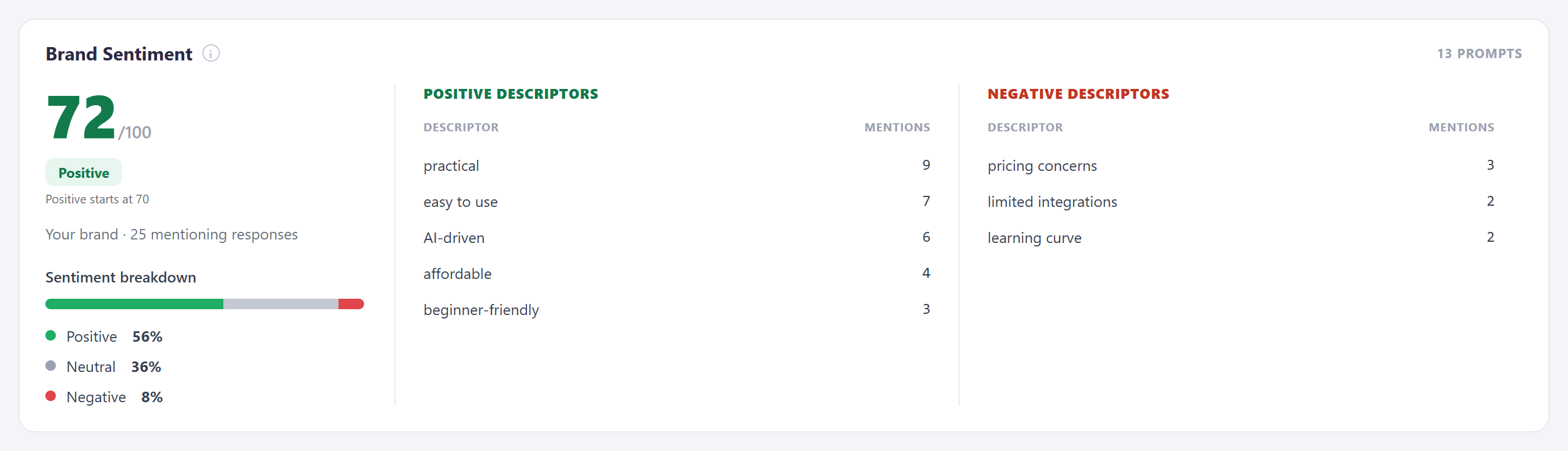 The headline is a 0–100 score with its scale printed right beside it — 72/100, Positive, and the line that makes the number readable: Positive starts at 70. No guessing whether 72 is good; the scale, the band word, and the benchmark all sit together. And the band always matches the number honestly — a 30 reads Negative, never a euphemism — and when a score sits below a band, the same line tells you the target to clear, so you know exactly how far a 66 is from the 70 that would make it Positive.
Everything on this screen is scoped to the specific brand you’re viewing — the score, the split, and both descriptor tables describe your brand and nothing else. If your brand name collides with another company’s, a banner flags it, so you never mistake a stranger’s tone for your own.
Just as important is the small caption under the badge: the score is built on your mentioning responses — the tracked answers that actually talk about your brand (here, 25 of them). An answer that never mentions you carries no tone to measure, so it isn’t counted. Keep that basis in mind when the mention count is small: fewer mentions means each one moves the number more. When there genuinely isn’t enough to score yet, the screen says so plainly — “Not enough data yet” — rather than painting absent data as a red verdict.
The sentiment breakdown shows the share of positive, neutral, and negative descriptors — 56% / 36% / 8% here, which sums to exactly 100%. A healthy profile usually looks like this: a positive lead, a substantial neutral middle (much of what AI says about any brand is simply descriptive), and a thin negative tail worth reading closely.
The descriptors — where the score becomes actionable
Section titled “The descriptors — where the score becomes actionable”The two descriptor tables are the real intelligence on this screen. Positive descriptors are the words AI repeatedly uses when it recommends you — “practical,” “easy to use,” “AI-driven” — each with a mention count. This is your earned vocabulary: language the answers already associate with you, which makes it the strongest raw material for your own pages and positioning.
Negative descriptors are the short list to work through, and the first question for each one is: is this a perception problem or a fact problem?
- “Pricing concerns” next to a Brand Intelligence gap where an engine claims a phantom $499 price isn’t a tone issue — it’s a wrong fact wearing a sentiment costume. Fix the fact; the descriptor follows.
- “Limited integrations” beside an engine claiming you integrate “only with Toast” is the same pattern — the integrations page fix serves both screens.
- A descriptor with no wrong fact behind it — “learning curve” — is the genuine article: real perception, addressed with content and product, not corrections.
If a descriptor column comes up empty, the screen tells you why rather than leaving a blank space — usually that there aren’t yet enough mentions of that polarity to list, which is itself a small finding.
Read the words before you react to the number. A score moving two points tells you less than a new descriptor appearing. Treat the score as the trend line and the descriptor tables as the work list — and route every negative descriptor through the “fact or perception?” question before spending on either fix. The dashboard’s Performance Trends panel now lets you view that trend line at daily, weekly, or monthly grain, so you can match how closely you watch it to how fast your answers are moving.
Small samples read loosely. Sentiment built on a handful of mentions — a platform where you appear only twice, an early week of tracking — is provisional by nature; the product itself declines to score sentiment on too few mentions, reading “Not enough data yet” rather than inventing a number. Give a new or thin segment a few periods before treating its tone as a finding.
Common questions
Section titled “Common questions”Why is the score based on 25 responses when I track 60? Only responses that mention your brand carry sentiment about it. The other 35 are silent on you — that’s a coverage problem (a different screen), not a tone one.
Is 72 actually good? It’s inside the Positive tier, which starts at 70 — genuinely positive, with headroom. The more useful read is relative and directional: how it compares to your rivals’ scores, and which way it’s moving.
How do I see the same picture for competitors? Competitor Sentiment Profiles gives every tracked rival the same treatment — score, tier, and the descriptor language each one earns, all on the same scale as this screen. Reading yours and theirs together is how you find the positioning ground nobody owns.
A negative descriptor is flat-out based on wrong information — what now? That’s the best kind of negative: run Brand Intelligence, confirm the wrong claim behind it, and ship the fact fix. Tone built on misinformation corrects at the source.
How fast does sentiment change after I fix things? On the same lag as everything AI-derived — answers update as engines re-crawl and re-source, which takes weeks, not days. Watch the descriptor tables across periods; new positive language appearing is usually the first visible sign.
What to read next
Section titled “What to read next”- Competitor Sentiment Profiles — the same lens on every rival; your positioning map.
- Brand Intelligence — where negative descriptors built on wrong facts get dismantled.
- Action Center — the fixes and content that change what the answers say next period.