Competitive AI Performance
What this is for, in one sentence: the head-to-head table — you and every tracked rival, side by side, on the same six measures, so a number like “41.7% coverage” finally has context.
When to come here: whenever you’re tempted to ask “is my number good?” — this screen is the answer. Also before any pitch, board meeting, or client review: nothing lands like “here’s exactly where we stand against the rivals you care about.”
We continue with Sarah at MenuPilot and her four tracked competitors.
Reading the table
Section titled “Reading the table”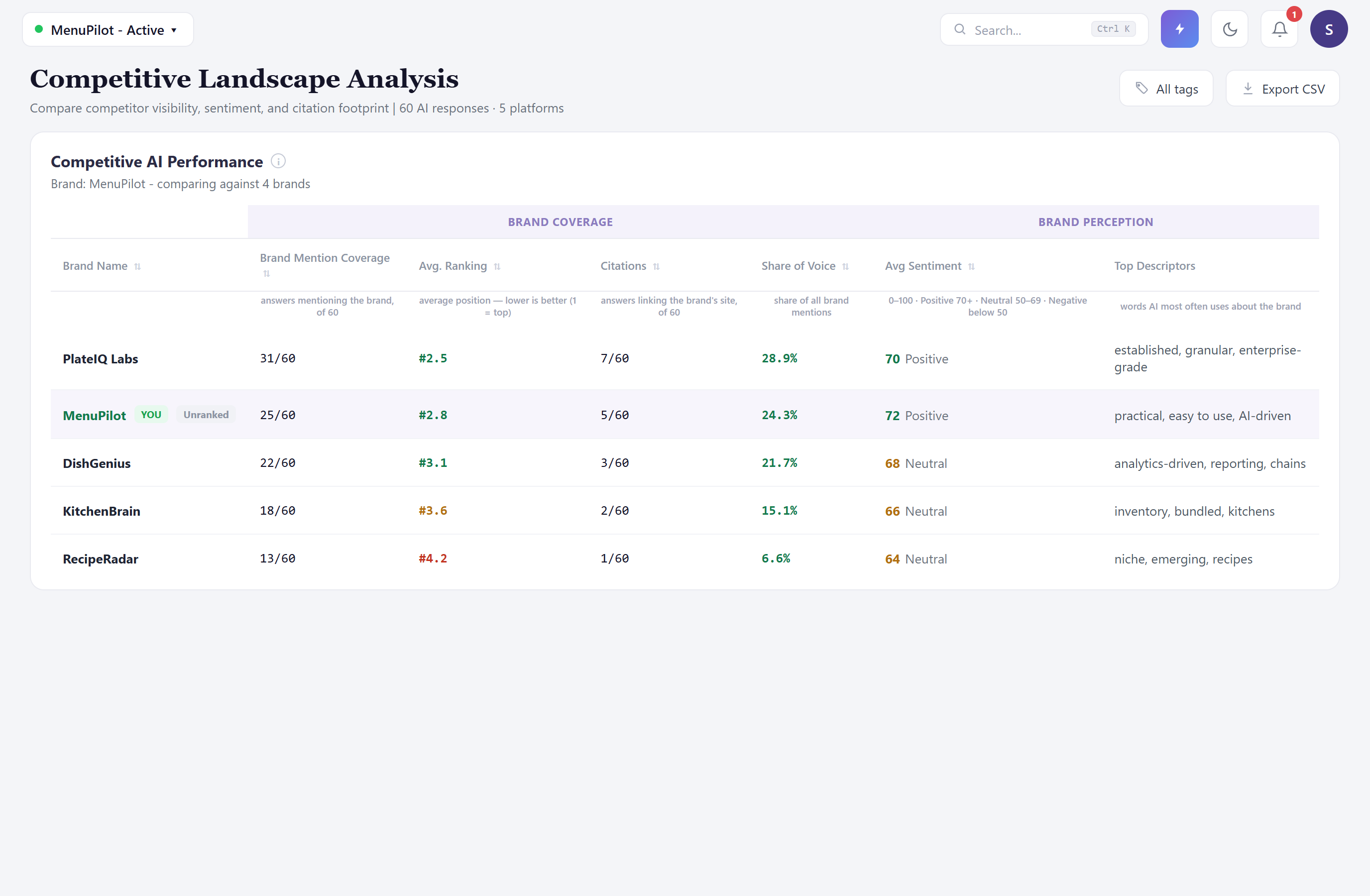
Every tracked brand gets a row with the same measures you know from the dashboard — Mention Coverage, Share of Voice, Citations, Average Ranking, Average Sentiment — plus Top Descriptors (the actual words AI uses about each brand). Your own row carries the YOU highlight so you can always find yourself at a glance, alongside an Unranked badge — Zicy doesn’t hand your own brand a competitive rank number (you’re the reference point, not a ranked rival).
A subtitle under the heading tells you exactly who’s in the comparison — it names the number of competitors you’re tracking and links straight to where you edit that list, so the table never leaves you guessing about its own scope.
Each column header carries a short definition of what it measures, and a single benchmark legend explains the colour dots once for the whole screen: green means strong, amber means middling, red means weak — and they mean the same thing in every column. That’s what makes the strategic read fast:
- Scan your row for red — those are your weak measures.
- Scan each column for green — that’s who to study on each measure.
- Find the near-ties — Sarah trails PlateIQ Labs on coverage (41.7% vs 51.7%) but leads on sentiment (72 vs 70). Close races are where effort pays fastest.
Two consistency details worth knowing. The rank badges and the Average Ranking figure read against the same benchmark tiers, so a badge and the number beside it always tell the same story. And the Average Sentiment column uses the very same 0–100 scale as Brand Sentiment (M-07) — a 72 here means exactly what a 72 means there.
One reading habit that prevents wrong conclusions: a rival can lead on one measure and trail on another — PlateIQ is mentioned more often, but when MenuPilot appears, AI speaks slightly more warmly of it. There’s no single “winner” column; the story is the pattern.
Why your Share of Voice percentages don’t sum to 100
Section titled “Why your Share of Voice percentages don’t sum to 100”Add up the SoV column and you’ll get less than 100%. Not a bug: AI answers also mention brands you aren’t tracking — small players, adjacent tools, one-off names. Their mentions sit in the denominator. When one of those keeps appearing, Zicy surfaces it on this screen with an Untracked label so you can see it working its way in without it quietly distorting your tracked numbers — and if it earns a place, you can add it to your set in a click.
Top Descriptors — the narrative column
Section titled “Top Descriptors — the narrative column”The most underrated column. Each brand’s cell shows the handful of words AI most attaches to it across all answers — the compressed version of every framing you’d find reading answers one by one. (Want the full per-rival breakdown with exact counts, including negative associations? That lives in Competitor Sentiment Profiles (M-08).)
Read your own descriptors and ask: is this the story we’re trying to tell? Sarah’s “practical, easy to use, AI-driven” matches her positioning — good. Read your rivals’ descriptors and ask: what story is AI telling for them that we could contest? PlateIQ owns “established” and “enterprise-grade” — which cedes “easiest for independents” to whoever claims it.
Who exactly are you being compared against?
Section titled “Who exactly are you being compared against?”Your competitor set is a saved list you own. Zicy seeds it for you from the brands that actually surface alongside you in AI answers, so you’re never starting from a blank page — but from that point on it’s yours to edit. Add a rival your sales team argues about, remove one that’s really from a neighbouring category, and the whole table recalculates against the set you decided on. The subtitle at the top of the table links straight to that editing view; you can also manage the list from setup.
Because every number on this screen — and Share of Voice everywhere — depends on who’s in the set, it’s worth a quick sense-check before you quote the table:
- Are these the rivals you actually lose deals to? If a brand belongs in the comparison, add it. If one keeps surfacing in your answers but isn’t saved yet, you’ll see it labelled Untracked — a one-click prompt to fold it in.
- Anything that looks like a duplicate? You shouldn’t see one: Zicy de-duplicates competitor entities, so a single company can’t appear as two rows and split its numbers into two smaller ones. The CSV export runs the same de-duplication, so what you hand a client matches what’s on screen.
- Anyone irrelevant? A brand from a neighbouring category inflates the denominator — remove it from the set rather than mentally discounting it.
Common questions
Section titled “Common questions”A competitor’s numbers look strangely low — are they really that invisible? Check two things first: how recently they started appearing (a newly-surfaced rival has thin data that reads as weakness), and whether they were only just added to your set. Then believe the number — you won’t see the same rival split across duplicate rows, because Zicy de-duplicates entities automatically.
Can I choose who I’m compared against? Yes. The competitor set is a saved, editable list — add or remove rivals from the link in the table’s subtitle or from setup, and the table recalculates against your choices. Zicy seeds the list from the brands AI names alongside you, but the final say is yours. Shaping your prompts (M-02) still influences which new brands surface as candidates.
My own row says “Unranked” but also shows an Average Ranking — which is right? Both — they measure different things. Unranked just means Zicy doesn’t hand your own brand a competitive rank number in this table (you’re the reference point, not a ranked rival). Average Ranking (e.g. #2.8) is a separate metric: your typical position inside AI answers. Quote the Average Ranking — “typically the 2nd–3rd brand AI names” — and read the table by comparing your columns against each rival’s.
Do competitors cost extra quota? No — they’re measured from the same AI answers your prompts already generate. Prompts cost quota; competitor tracking doesn’t.
What to do next
Section titled “What to do next”- See the words behind each rival’s sentiment score: Competitor Sentiment Profiles (M-08).
- Find the topics where each rival beats you: Key Topics Analysis (M-09).
- See whose websites AI trusts: Citation Analysis (M-10).